
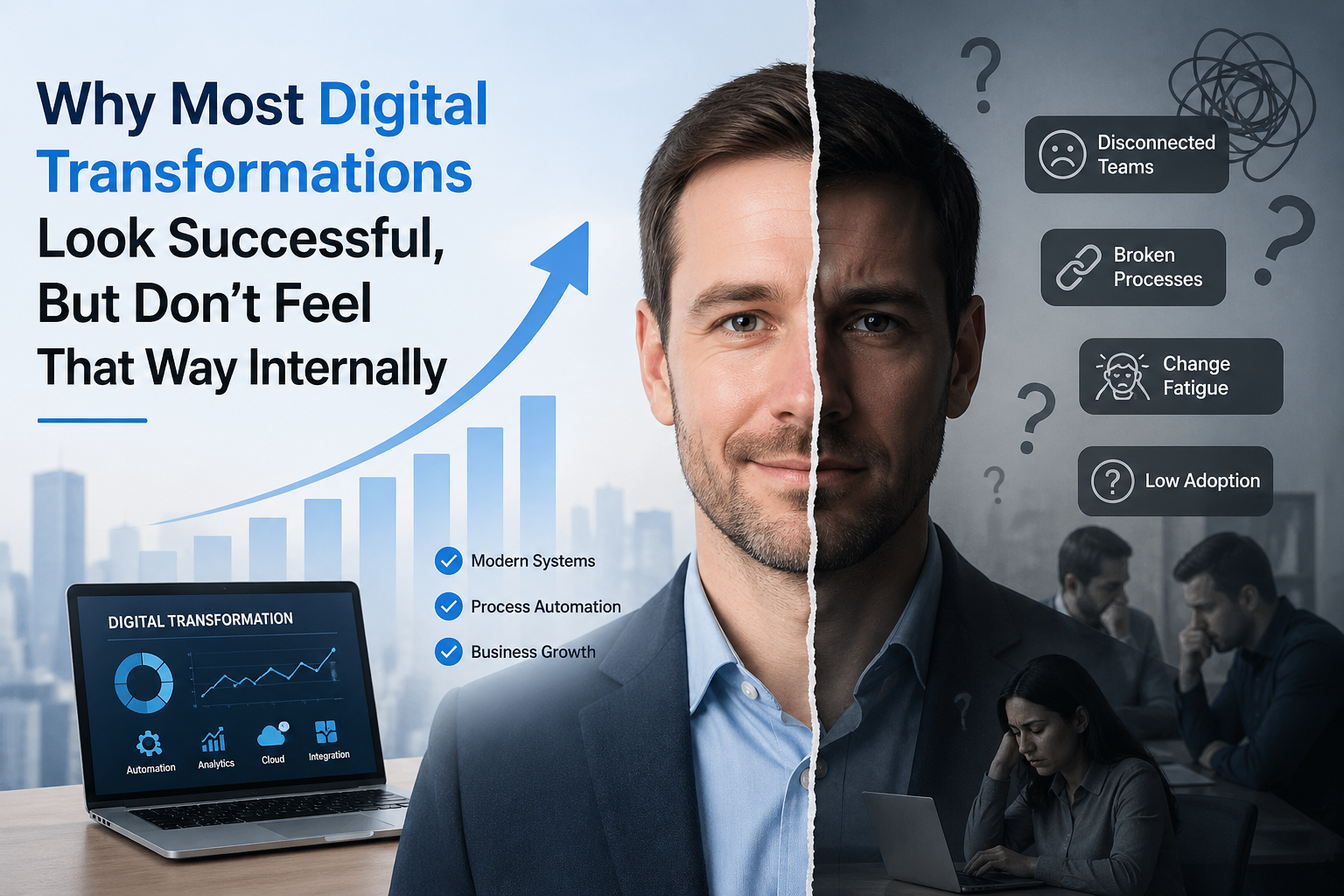

From the outside, a digital transformation often looks like a big win.
New systems are launched. Dashboards look cleaner. Processes are “automated.” There’s a sense of progress.
Teams are trained. Tools are adopted. Things move forward.
And yet, inside the business, the feeling is often very different. Work still feels heavy. Teams still follow up constantly. Data still needs validation. Nothing is technically wrong. But something still doesn’t feel right.
The Difference Between “Built” and “Working”
One of the biggest misunderstandings around digital transformation is this: Just because something is built… doesn’t mean it’s working.
A system can be fully functional. It can process data. Generate reports. Support workflows.
And still not solve the actual problem. Because the real issue isn’t whether the system works. It’s whether it fits.
Most Transformations Start With the Wrong Focus
A lot of digital projects begin with tools.
Which platform to use. Which software to build.Which features to include. These are important decisions. But they come too early. Before choosing tools, there’s a more important question: “How does work actually happen right now?”
And more importantly: “Where does it break?” Without understanding that, systems get built around assumptions.
Assumptions Don’t Scale
In the early phase, assumptions feel accurate. The workflow looks clean. The process seems logical. Everything fits on paper.
But real work is rarely that simple. There are exceptions. There are delays. There are manual interventions. And these details don’t always get captured during planning. So when the system goes live, it reflects an ideal version of the business, not the real one.
Teams Start Adjusting Again
Once the system is in place, teams begin adapting. They find small gaps. A step that doesn’t quite work. A report that needs manual correction. A process that requires confirmation outside the system.
So they adjust. They create quick fixes. They rely on communication. They add manual steps. And slowly, the system starts drifting away from its intended design.
The System Works, But the Work Doesn’t
This is where things become confusing. From a technical perspective, everything is fine. The system is stable. The features are working. The output is generated.
But from a user perspective, it feels incomplete. Because the system isn’t supporting the work fully. So people step in. And once people start compensating, efficiency drops.
Why Automation Doesn’t Always Reduce Effort
Automation is often seen as the solution. And it can be. But only when the underlying process is clear. If a process already has gaps, automating it doesn’t fix the gaps. It scales them. Now instead of manual confusion, you have automated confusion. Faster, but still confusing.
Integration Is Where Most Value Comes From
What many businesses overlook is how important integration is. Most companies don’t operate with one system. They have multiple tools.
CRMs. Finance systems. Operational platforms. If these systems don’t connect properly, data gets fragmented. Teams spend time reconciling information instead of using it. And that’s where efficiency is lost.
Real Transformation Feels Different
When systems actually align with how work happens, the change is noticeable. Not in a dramatic way. But in small, consistent ways. Fewer follow-ups. Fewer manual corrections. Fewer moments of confusion.
Work starts moving naturally. People trust the system. And that’s when transformation is real.
What Minterminds Focuses On
At Minterminds, the focus isn’t just on building systems. It’s on understanding how businesses operate in reality. Not how they should operate. But how they actually do. Where work slows down. Where people step in. Where systems don’t connect. Because once those points are clear, the solution becomes obvious.
Final Thought
Digital transformation isn’t about adding more technology. It’s about making technology work better. A system doesn’t need to be complex to be effective. It needs to be aligned.
Aligned with workflows. Aligned with data. Aligned with people. Because when that alignment exists, everything changes. Work becomes smoother. Decisions become faster. Growth feels manageable again.
And that’s when transformation stops being something you see… and starts being something you feel.