
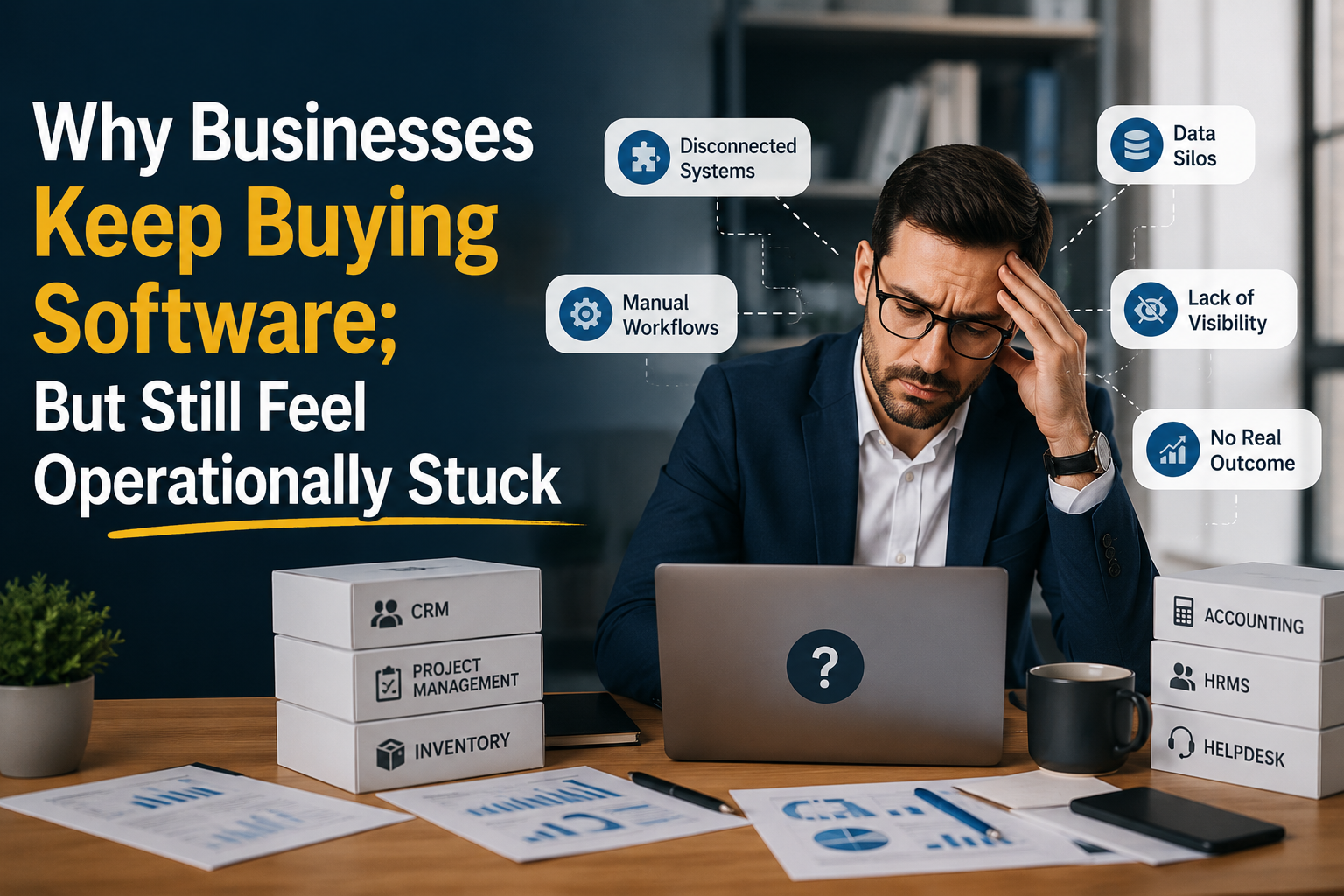

There’s a pattern that shows up in a lot of growing businesses. Every few months, a new tool gets introduced. A better CRM. A smarter analytics dashboard. A new automation platform. A project management system that promises “full visibility.”
For a while, it feels exciting. Teams explore features. Processes get adjusted. There’s a sense that things are finally becoming more organised.
But after some time, the same frustrations quietly return. People still follow up constantly. Reports still need manual checking. Teams still maintain side spreadsheets “just to be safe.” And eventually someone asks the question: “If we already have so much software… why does work still feel messy?”
More Software Doesn’t Automatically Create Better Operations
This is the misunderstanding most businesses run into. Technology improves capability. But capability and operational clarity are not the same thing. A company can have excellent tools and still operate inefficiently. Because tools alone don’t define how work moves. Structure does.
The Real Problem Usually Starts Between Systems
Individually, most business tools work well. The CRM captures customer information. The finance platform tracks billing. The operations dashboard monitors workflows. The issue appears in the space between them.
One system updates slower than another. Data gets duplicated. Teams rely on manual confirmation because they don’t fully trust what they’re seeing.
And once trust in systems drops, people start compensating. That’s where operational drag begins.
Teams Quietly Build Their Own Workarounds
This part is interesting because it happens almost invisibly. Nobody officially decides to stop relying on systems. It just happens gradually.
Someone creates a spreadsheet because reporting feels inconsistent.
Another person starts tracking approvals manually.
A manager asks for updates through messages instead of checking the dashboard. None of this feels dramatic.
But over time, the real workflow shifts outside the system. Now work depends on people remembering things instead of systems handling them reliably.
Complexity Builds Faster Than Most Businesses Expect
What works at smaller scale often breaks under growth. In the beginning, teams can manage inefficiencies manually because the volume is manageable.
But growth changes the equation. More customers. More transactions. More internal coordination.
The same small inefficiencies now repeat hundreds of times every week.
And suddenly, the business feels heavier. Not because people are underperforming. But because the system underneath them wasn’t designed for this level of complexity.
Why Adding Another Tool Usually Makes It Worse
At this stage, businesses often react the same way: They buy another solution. Something that promises visibility, automation, or operational efficiency. But if the underlying structure is already fragmented, adding more software increases fragmentation.
Now there are:
More integrations
More data flows
More dependencies
More chances for inconsistency
The system becomes harder to manage, not easier.
Most Operational Problems Are Actually Flow Problems
This is the shift many companies eventually realise. The issue isn’t missing technology. It’s broken flow.
- How information moves.
How tasks transition between teams. - How systems communicate with each other.
If flow is inconsistent, operations slow down naturally.
Even good employees end up spending time coordinating instead of executing.
Visibility Doesn’t Matter If Data Isn’t Trusted
A lot of businesses invest heavily in dashboards. But dashboards only help if the underlying data is reliable. If teams constantly question numbers, the dashboard loses value immediately.
Meetings stop being about decisions.
They become about validation.
“Which report is correct?”
“Why doesn’t this match finance?”
“Did the data refresh properly?”
That uncertainty slows everything down.
Good Systems Reduce Mental Load
One thing people rarely talk about is how operational inefficiency affects focus. When systems are unreliable, employees carry extra mental load all day.
They remember manual checks.
They keep backup trackers.
They double-confirm information before acting.
It creates invisible fatigue. Not because the work itself is difficult, but because the system demands constant attention.
Good systems remove that burden. They allow people to trust the process. And when that happens, work becomes lighter.
What Minterminds Focuses On
At Minterminds, the goal isn’t simply to add more technology.
It’s to understand how businesses actually operate beneath the surface. Where work slows down. Where systems disconnect. Where teams compensate manually.
Because once those friction points become visible, the solution usually becomes much clearer. Sometimes it requires automation. Sometimes integration.
Sometimes simplifying workflows entirely. But the starting point is always the same: Understanding flow.
The Businesses That Scale Smoothly Usually Get This Right Early
Companies that scale efficiently aren’t always the ones with the most tools.
They’re usually the ones with the cleanest operational structure.
Their systems communicate clearly.
Their data flows consistently.
Their teams trust the information they’re working with.
That creates speed. Not rushed speed. Operational speed. The kind that allows growth without creating chaos.
Final Thought
Most businesses don’t struggle because they lack software. They struggle because the software they already have isn’t working together properly. And when systems stop supporting flow, people step in to fill the gaps.
That works temporarily. But eventually, those small gaps become operational weight.
Fixing that doesn’t always require more technology. Sometimes it requires stepping back and redesigning how the business actually moves.