

Right now, almost every business wants AI.
Some want AI automation.
Some want AI-powered analytics.
Some want AI integrated into customer workflows.
The interest is massive.
And honestly, it makes sense.
AI promises efficiency, speed, prediction, personalization—everything modern businesses are trying to improve.
But there’s a problem most companies don’t realise early enough.
AI usually fails long before the model itself becomes the issue.
The Assumption That AI “Fixes” Operations
A lot of businesses approach AI as a solution layer.
Something you place on top of existing operations to make everything smarter.
On paper, it sounds straightforward.
Add AI.
Reduce manual effort.
Increase productivity.
But AI doesn’t operate independently.
It depends entirely on the systems underneath it.
And if those systems are fragmented, inconsistent, or poorly structured, AI simply amplifies the chaos.
AI Is Only As Good As The Data Feeding It
This is probably the most underestimated part of AI implementation.
Businesses focus heavily on models.
Which LLM to use.
Which framework to deploy.
Which AI capabilities to integrate.
Meanwhile, the actual data environment remains messy.
Duplicate records.
Inconsistent formatting.
Disconnected systems.
Incomplete workflows.
Under these conditions, AI outputs become unreliable very quickly.
Not because the AI is weak.
Because the input quality is unstable.
Most Businesses Have Data Silos Without Realising It
In growing organisations, data naturally spreads across systems.
Sales data exists in the CRM.
Operations data lives somewhere else.
Customer support information sits in another platform entirely.
Individually, these systems work.
Collectively, they create fragmented context.
AI struggles in fragmented environments because intelligence depends on connected information.
Without unified flow, the system lacks operational understanding.
Automation Problems Become AI Problems
Another major issue happens when businesses automate broken workflows before introducing AI.
This creates layered inefficiency.
Manual confusion becomes automated confusion.
Automated confusion becomes AI-driven confusion.
Now the business is scaling bad processes faster.
And because AI outputs appear intelligent, teams sometimes trust incorrect recommendations longer than they should.
That makes debugging operational issues even harder.
AI Doesn’t Understand Your Business Automatically
There’s also a misconception that AI tools instantly adapt to business operations.
They don’t.
AI models require structure:
- Clear workflows
- Defined logic
- Reliable historical data
- Consistent operational patterns
Without those foundations, AI systems struggle to generate meaningful outputs.
This is why many implementations feel impressive in demos but disappointing in real operational environments.
The Real Bottleneck Is System Architecture
Most failed AI projects are actually architecture problems disguised as AI problems.
Poor integrations.
Inconsistent APIs.
Unstructured databases.
Delayed synchronization.
All of these issues reduce AI reliability.
Because modern AI systems don’t function in isolation.
They depend heavily on data pipelines, infrastructure design, and real-time operational flow.
AI Introduces New Infrastructure Demands
Once AI becomes operational, infrastructure pressure increases significantly.
More compute requirements.
Higher concurrency.
Continuous inference processing.
Large-scale vector search operations.
Systems originally designed for traditional applications often struggle under AI workloads.
Latency increases.
Response consistency drops.
Operational costs rise unexpectedly.
This is why scalable AI architecture requires planning far beyond model deployment itself.
Observability Becomes Critical In AI Systems
Traditional debugging already becomes difficult at scale.
AI systems add another layer of complexity.
Now businesses need visibility into:
- Model outputs
- Inference latency
- Data drift
- Prompt behavior
- Decision consistency
Without observability, teams cannot reliably understand why AI behaves differently across scenarios.
And unlike traditional software bugs, AI inconsistencies are probabilistic—not always reproducible.
That changes how systems must be monitored entirely.
Security And Governance Become Bigger Challenges
As AI systems access operational data, governance becomes increasingly important.
Who can access models?
What data is exposed?
How are outputs validated?
Without strong governance architecture, businesses create significant compliance and security risks.
Especially in industries handling financial, healthcare, or enterprise-level customer information.
Why AI Strategy Must Start Earlier
One of the biggest mistakes businesses make is introducing AI too late in system design.
AI should not be treated as an “add-on.”
It should influence:
- Data architecture
- Workflow structure
- Integration planning
- Scalability decisions
Because retrofitting AI into fragmented systems is far harder than building AI-ready infrastructure from the beginning.
What Minterminds Focuses On
At Minterminds, AI implementation is approached as a systems engineering challenge; not just a model deployment task.
The focus stays on:
- Clean architecture
- Reliable data flow
- Scalable infrastructure
- Operational alignment
Because successful AI systems depend less on flashy models…
and more on the quality of the environment supporting them.
Final Thought
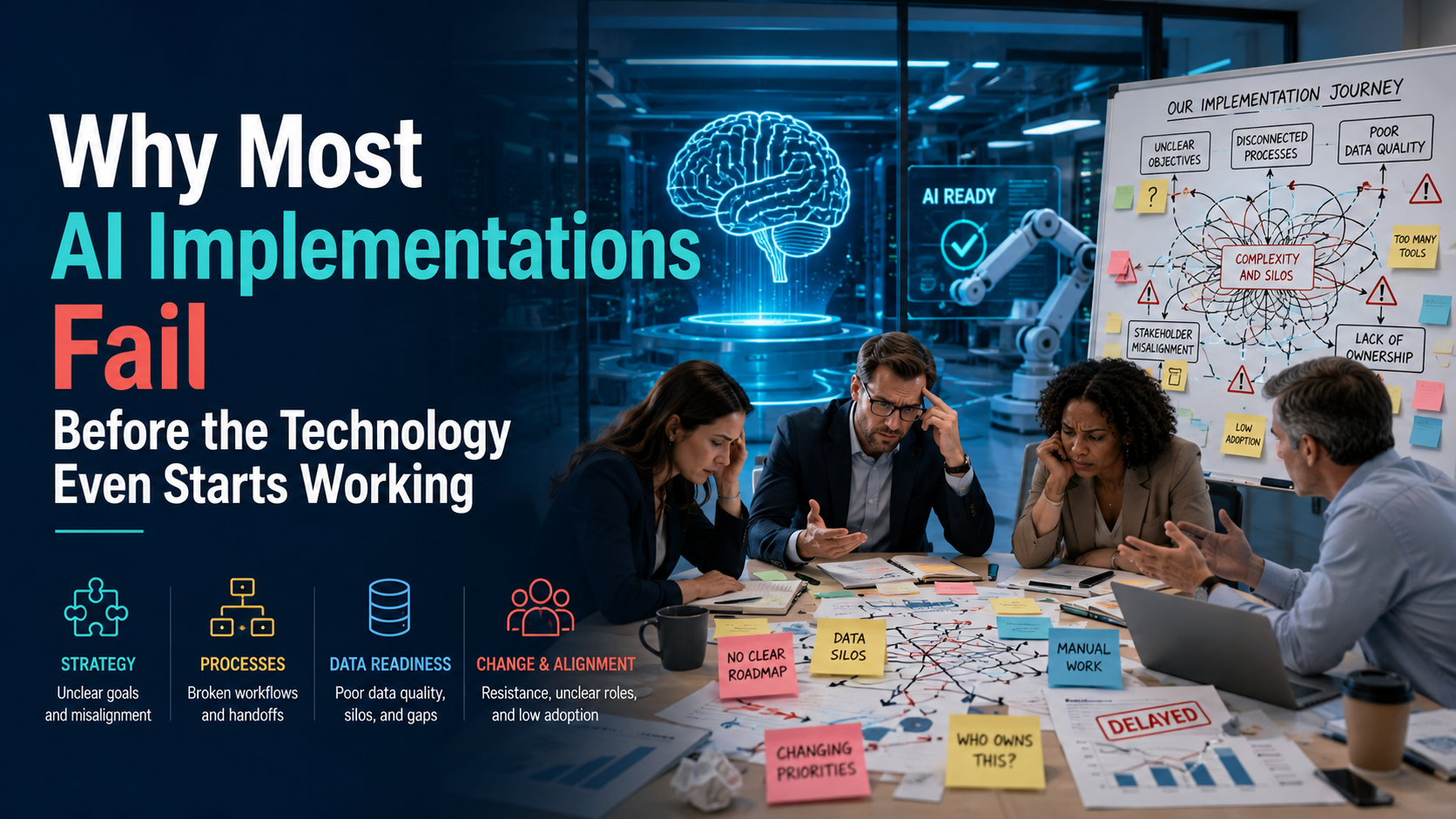
Most AI implementations don’t fail because the technology isn’t powerful enough.
They fail because businesses underestimate everything surrounding the technology.
AI exposes operational weaknesses faster than almost any other system layer.
Poor workflows become obvious.
Bad data becomes expensive.
Fragmented architecture becomes impossible to ignore.
That’s why successful AI adoption isn’t just about adding intelligence. It’s about building systems capable of supporting it properly.