

When businesses decide to build software, the conversation often starts the same way. The sales team needs a module.
The operations team wants a dashboard. Finance requires reporting. Management needs visibility. On the surface, this sounds logical.
Every department gets what it needs. Everyone is happy. The project moves forward.
But months later, something unexpected happens. The software works. Yet the business still feels disconnected.
Departments Don’t Operate In Isolation
One of the biggest mistakes in software design is assuming departments work independently.
They don’t. Sales affects operations. Operations affects finance. Finance affects leadership decisions.
Customer support influences product improvements. Everything is connected.
The problem is that many systems are designed as separate departmental solutions rather than a single operational ecosystem. And that creates friction.
The Handover Problem
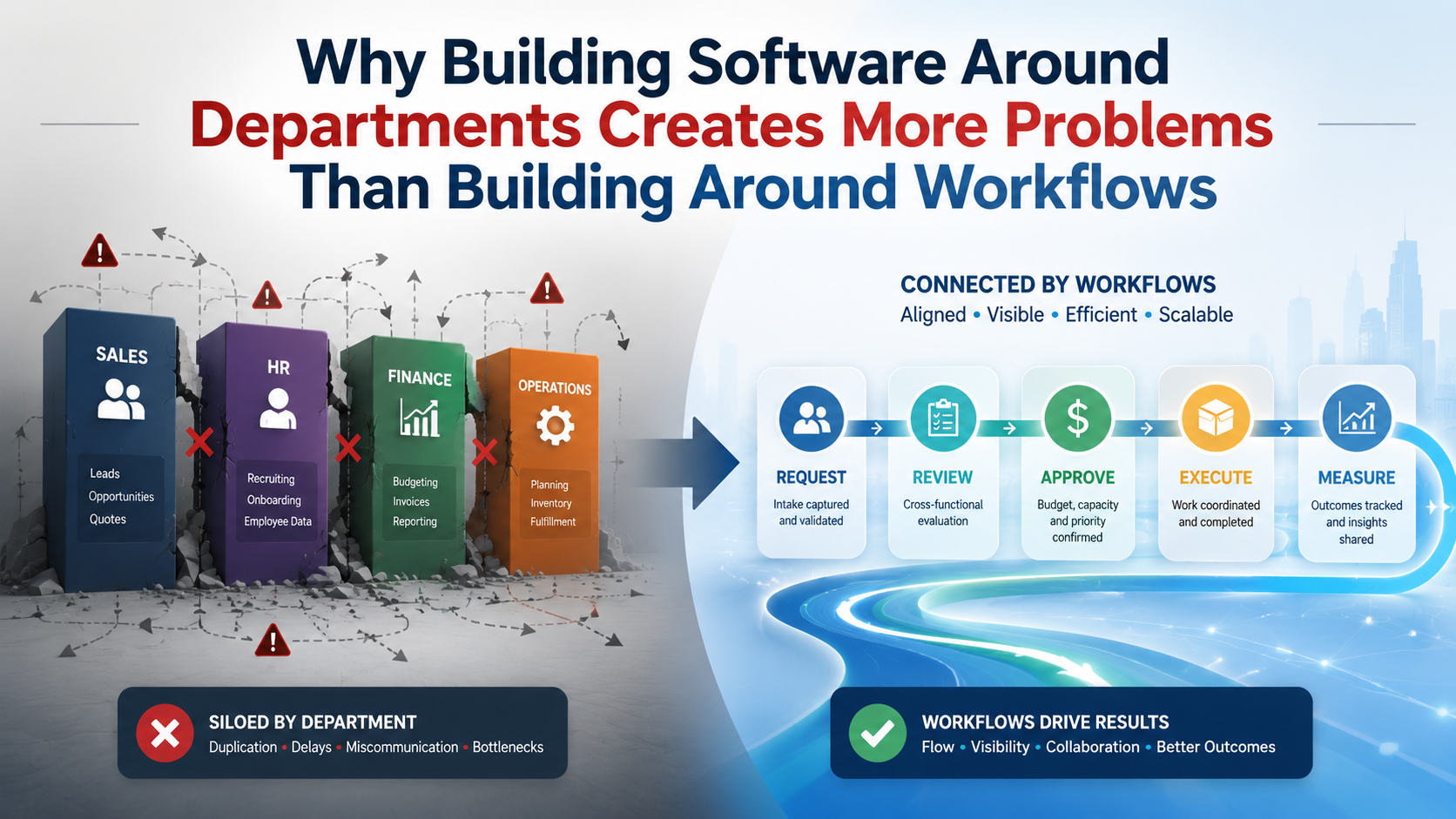
Every business process involves handovers. A lead becomes an opportunity. An opportunity becomes a customer. A customer generates operational work.
Operational work creates financial activity. Financial activity feeds reporting. Notice something? The workflow crosses departments continuously.
When systems are designed around departments instead of workflows, every handover becomes a potential failure point.
Information Starts Getting Lost
At first, the issue appears small. Someone updates information manually. Someone copies data into another system. Someone sends an email because a workflow wasn’t updated correctly.
These moments feel harmless. But they accumulate.
And eventually, information starts becoming inconsistent across teams.
Sales sees one thing. Operations sees another. Management sees something entirely different. Now nobody trusts the data completely.
More Dashboards Don’t Solve Misalignment
When visibility drops, businesses usually react by creating more dashboards.
More reporting. More analytics. More monitoring.
But visibility isn’t the same as alignment. A dashboard only shows information. It doesn’t fix how information moves.
If workflows remain fragmented, reporting simply exposes problems faster. It doesn’t solve them.
Workflow-Centric Design Changes Everything
Instead of asking: “What does each department need?”
A better question is:
“How does work move through the business?” This shifts the focus entirely.
Now the software is designed around flow rather than ownership. The goal becomes creating continuity. Not creating separate systems.
Good Systems Follow The Journey Of Work
Think about a customer order. The customer doesn’t care which department handles which step.
They care about the experience. From their perspective, it’s one journey. The software should reflect that reality.
The workflow should move naturally from one stage to another without requiring constant human intervention. That’s when systems start creating efficiency.
Why Integration Becomes Easier
Workflow-first design also improves integration. When systems are built around business flow, data naturally follows the same path.
Information doesn’t need excessive synchronization. Departments aren’t maintaining separate versions of reality.
The architecture becomes cleaner. The operational model becomes simpler. And scalability improves.
Teams Spend Less Time Coordinating
One hidden benefit of workflow-centric systems is reduced coordination overhead.
People stop chasing updates. Stop validating information repeatedly. Stop maintaining unofficial trackers. The system becomes the trusted source of truth.
And when trust exists, execution speeds up automatically.
Technology Should Mirror Reality
One of the reasons many enterprise systems struggle is because they’re designed around organisational charts.
But organizational charts change. Departments evolve. Responsibilities shift. Workflows, however, tend to remain more stable.
That’s why designing around how work happens is usually more effective than designing around who performs it.
What Minterminds Focuses On
At Minterminds, software development begins with understanding operational flow.
How information moves. How decisions happen. How teams interact. Only then does technology design begin.
Because successful systems don’t just support departments. They support the entire business process.
Final Thought
The best software rarely feels departmental.
It feels seamless. Work moves naturally. Information flows consistently. Teams stay aligned without constant effort.
And that’s usually the difference between software that simply exists and software that genuinely improves business performance.
Because in the end, businesses don’t scale through departments. They scale through workflows.