
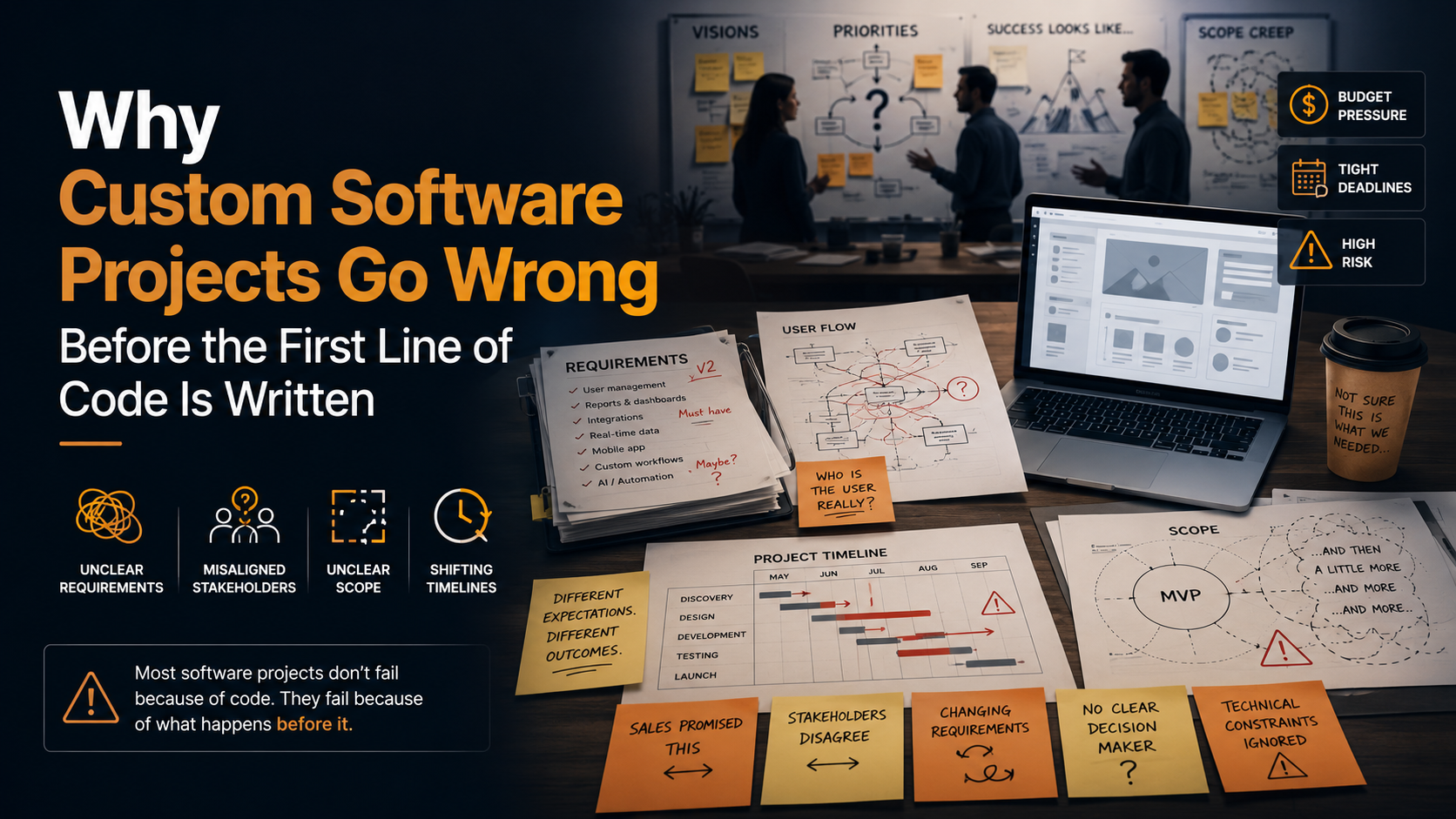

When a software project struggles, people usually look at development first.
Maybe the code quality was poor. Maybe the technology stack was wrong. Maybe the team underestimated the timeline.
Those things can certainly create problems. But in many cases, the project was already heading in the wrong direction before a developer opened the code editor.
The problem started much earlier. It started when the business knew it wanted software, but had not clearly worked out what the software was supposed to change.
That gap sounds small. In reality, it influences almost every decision that follows.
“We Need an App” Is Not a Complete Requirement
A surprising number of software conversations begin with a solution rather than a problem.
“We need a mobile app.” “We want a customer portal.” “We should automate this process.”
These statements sound clear, but they leave out the most important part: why?
What problem is the app solving? Who is experiencing that problem? What currently happens without the software? What would improve if the project succeeds?
Without these answers, a project can become a long list of features that look useful but do not work together toward a clear outcome.
The team may successfully build everything that was requested and still deliver something the business does not really need.
Feature Lists Create a False Sense of Clarity
At the beginning of a project, feature lists feel productive.
Login system. Dashboard. Notifications. Reports. Admin panel. Payment integration.
The list keeps growing, and the project starts looking more complete.
But a feature list does not explain how the product should behave as a whole.
Two applications can contain the same features and still create completely different user experiences. The difference lies in the workflow connecting those features.
For example, adding an approval feature is easy to describe. The difficult part is understanding who initiates the approval, who can reject it, what happens after rejection, whether it can be reassigned, and how every decision should be recorded.
The feature itself may take one line in the document. The real business logic behind it can take weeks to understand properly.
The Documented Process Is Often Not the Real Process
Most businesses already have processes written somewhere.
There may be standard operating procedures, flowcharts, spreadsheets, or internal manuals explaining how work is supposed to happen.
The trouble is that people rarely follow those processes exactly.
Real work contains exceptions.
A manager may approve something over a phone call because the request is urgent. A team member may keep a separate spreadsheet because the main system does not show enough detail. Someone may skip a step because it creates unnecessary delay.
These adjustments are usually invisible during early requirement discussions.
If software is designed only around the official process, it may fail the moment it enters the real workplace.
That is why discovery should involve more than asking management what the process looks like. It should include the people who actually perform the work every day.
They know where the delays are. They know which steps are repeated. They know which information is usually missing.
That practical knowledge often shapes better software than a formal process document ever could.
Building Around Assumptions Creates Expensive Rework
Every unclear decision eventually becomes an assumption.
A developer assumes how a notification should work. A designer assumes which information matters most on the dashboard. A project manager assumes that two departments follow the same process.
Sometimes those assumptions are correct. Sometimes they are not discovered until testing.
By then, the system architecture may already depend on them. Changing a label is easy. Changing the underlying workflow after development is much harder.
It can affect database structures, APIs, user permissions, reports, and integrations. A misunderstanding that would have taken one meeting to resolve early can require several weeks of rework later.
This is why strong software planning is not wasted time. It is one of the most effective ways to protect the development budget.
User Roles Are More Complicated Than They Appear
Many projects define users too broadly.
Admin. Manager. Employee. Customer.
That may look sufficient initially, but real organisations often have far more complicated access requirements.
Can every manager see the same information?
Can a regional manager access data from another region?
Can a finance user edit customer details?
Should an employee be able to see a record after it has moved to another department?
These questions affect both usability and security.
If permissions are poorly planned, the system may either expose information too widely or restrict users so heavily that they create workarounds outside the platform.
Good access control is not simply about adding roles. It is about understanding what each person needs to view, create, change, approve, and export.
That level of detail is essential in enterprise and custom software development.
Integrations Need to Be Discussed Early
Integrations are often treated as a later phase.
The core software is built first, and connections with the CRM, accounting system, payment gateway, or analytics platform are considered afterwards.
This can create serious complications.
Every external system has its own data structure, authentication method, limitations, and update cycle. Some provide clean APIs. Others depend on scheduled exports. A few may not support the required workflow at all.
These constraints can influence the architecture of the entire project.
For instance, if a third-party system does not support real-time updates, the new application must be designed around delayed synchronization. If the integration can fail, the software needs retry logic, error reporting, and reconciliation workflows.
Ignoring these realities early does not make them disappear. It simply makes them more expensive to solve later.
Scalability Should Be Defined, Not Assumed
Almost every client wants scalable software.
But “scalable” means different things to different businesses.
Does it mean supporting more users? Handling more transactions? Launching in multiple countries? Adding new product lines? Connecting more third-party platforms?
A system designed for 500 internal users has different requirements from a consumer application expecting lakhs of daily requests. Both need scalability, but not in the same way.
Overengineering creates unnecessary cost and complexity. Underengineering creates performance problems later.
The right architecture depends on realistic growth expectations, not vague ambitions.
The First Version Should Solve the Core Problem
Many projects become too large before they begin.
Every stakeholder adds something. A reporting feature. A communication module. An AI capability. Another dashboard. Soon, the first release is expected to solve every possible need.
This delays launch and makes testing difficult.
A better first version focuses on the core problem that justified the software in the first place. It should create measurable value even without every planned feature.
Once real users interact with it, the team gains information that no planning session can provide.
Which steps confuse people? Which features are ignored? Where do users leave the process?
That feedback helps shape the next release based on actual behaviour instead of assumptions.
Where Minterminds Begins
At Minterminds, software development does not begin with code.
It begins by understanding the business behind the request.
How work moves today. Where information gets delayed. Which tasks depend on manual effort.
What needs to improve after the system goes live.
Only after those questions are clear does the technical planning begin.
This approach influences the architecture, interface, integrations, access control, and release roadmap. More importantly, it keeps the project connected to the business problem it was meant to solve.
Final Thoughts
The quality of software is not decided only during development.
It is shaped during the conversations that happen before development begins.
Clear workflows create better architecture. Real user input creates better usability. Early integration planning prevents expensive surprises. Focused requirements create faster, more meaningful releases.
Writing code is a major part of building software, but it is not the first challenge.
The first challenge is making sure everyone understands what should be built, why it matters, and how it will work in the real business.
Once that foundation is right, the technology has a much better chance of being right too.