
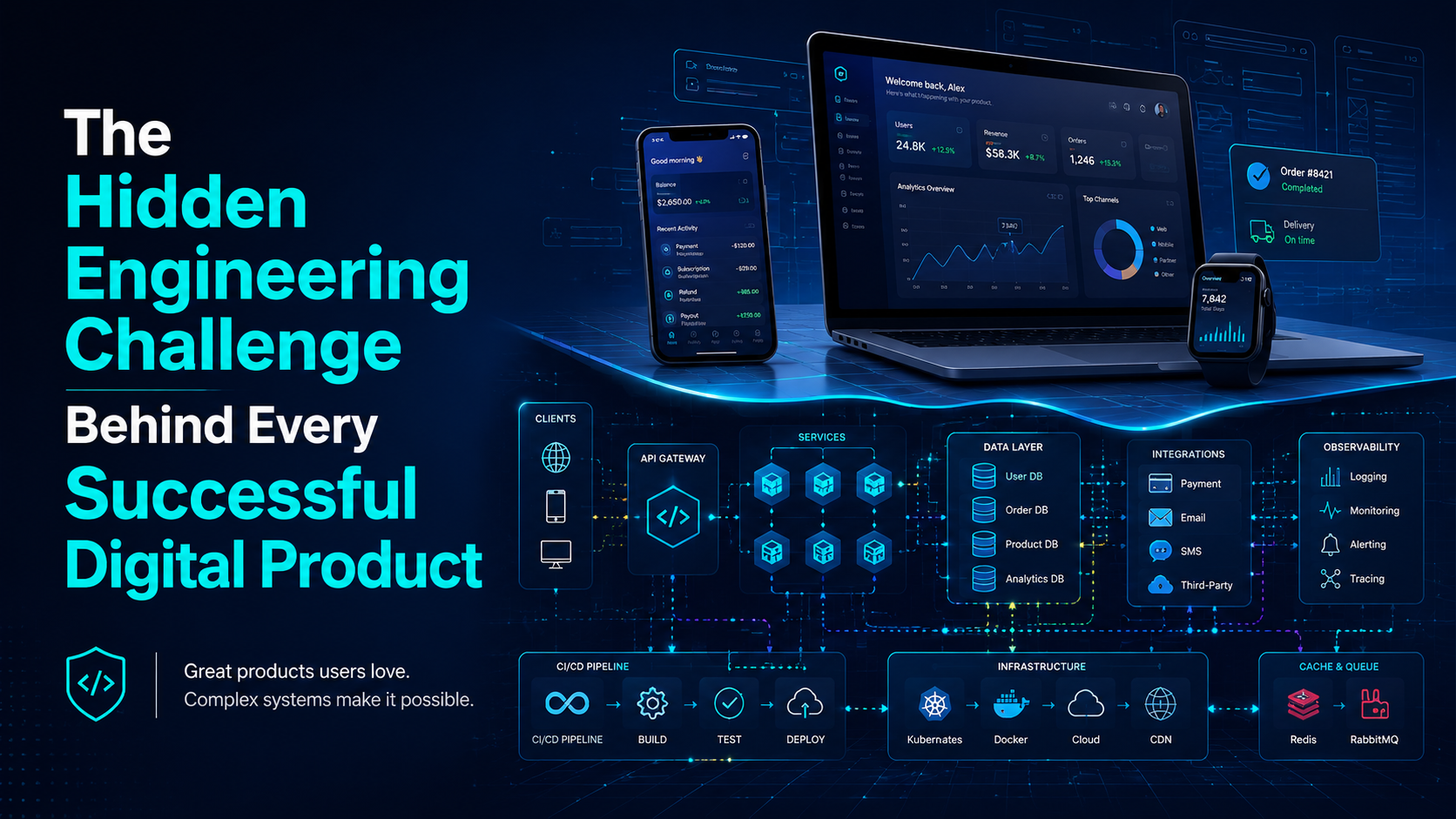

When people look at a successful software product, they usually notice the visible parts.
The interface. The features. The user experience. The dashboards.
What they rarely see is the engineering challenge happening underneath.
Because in reality, building software isn’t usually the hardest part. Keeping it reliable while it grows is. And that’s where many products start struggling.
Every System Looks Scalable In The Beginning
During the early stages, software feels fast. Users are limited. Data volumes are manageable. Workflows are straightforward.
A single server can handle traffic. A few APIs are enough. Monitoring is simple. Everything appears scalable.
The problem is that early success often creates confidence in architecture that hasn’t truly been tested yet.
Growth Changes Everything
A product that serves 100 users behaves very differently from one serving 10,000.
And a product serving 10,000 users behaves very differently from one serving 100,000. The code may remain the same. But the environment changes completely.
More requests. More transactions. More integrations. More dependencies. More opportunities for failure.
This is when software stops being a development challenge and becomes a systems challenge.
Performance Problems Are Usually Symptoms
When businesses experience slow systems, they often focus on the visible issue. The dashboard takes longer to load.
Reports are delayed. Workflows become sluggish.
The immediate assumption is performance. But performance problems are usually symptoms rather than causes.
The deeper issue often sits inside the architecture itself. How services communicate. How data is stored. How requests move through the system.
Modern Software Is No Longer One Application
Years ago, applications were simpler. One codebase. One database. One deployment.
Today, most business systems are ecosystems. Customer platforms. CRMs. Analytics engines. Payment gateways. Communication systems. Cloud services. Third-party APIs.
The challenge is no longer building individual components.
The challenge is making everything work together consistently.
Data Flow Determines System Health
One of the most overlooked areas in software engineering is data flow. Most teams focus heavily on features.
But long-term stability depends on how information moves.
- Where does the data originate?
- How is it transformed?
- Which systems consume it?
- How quickly does it update?
A feature can work perfectly. But if the underlying data flow is inefficient, operational problems appear sooner or later.
Integration Is Where Complexity Multiplies
Every new integration introduces risk. One external API changes. A third-party service experiences downtime. Data formats evolve. Authentication requirements shift.
Suddenly, workflows that previously worked become unstable. This is why integration architecture matters as much as application architecture. The more systems involved, the more important reliability becomes.
The Cost Of Poor System Design Appears Later
Poor architecture rarely causes immediate failure. That’s what makes it dangerous. The system launches successfully.
Customers use it. The business grows. Then complexity starts accumulating. New features take longer to release. Debugging becomes harder. Infrastructure costs rise.
Teams become cautious about deployments. The software still works. But it becomes progressively harder to evolve.
Engineering Teams Start Fighting Complexity
At this stage, developers spend less time building and more time managing. Managing dependencies. Managing technical debt. Managing deployment risks.
Managing unexpected side effects. Productivity drops. Not because the team lacks talent. Because complexity has become the primary workload.
Scalability Is More Than Infrastructure
Many businesses assume scalability means adding servers. Increasing cloud resources. Expanding infrastructure. Infrastructure matters. But scalability starts much earlier.
It starts with architecture.
- Can services operate independently?
- Can workloads be distributed efficiently?
- Can failures be isolated?
- Can data remain consistent under growth?
Without those foundations, infrastructure alone cannot solve scaling problems.
Observability Has Become Essential
Modern systems generate enormous amounts of activity. Requests. Events. Transactions. Integrations. Without visibility into these activities, diagnosing issues becomes difficult.
This is why engineering teams increasingly depend on:
- Real-time monitoring
- Distributed tracing
- Centralized logging
- Performance analytics
Observability isn’t just about finding problems. It’s about understanding how complex systems behave.
Why Businesses Need Engineering Partners, Not Just Developers
Building software today requires more than coding expertise.
It requires understanding:
- System architecture
- Infrastructure planning
- Integration strategy
- Scalability requirements
- Operational workflows
The goal isn’t simply to create software. The goal is to create systems that remain effective as businesses evolve.
Where Minterminds Comes In
At Minterminds, software development is approached from a systems perspective. Not just what needs to be built. But how it will perform six months later.
A year later. After new users arrive. After new integrations are added. After business requirements change. Because successful software isn’t defined by launch day. It’s defined by how well it adapts to growth.
Final Thought
The strongest digital products aren’t always the ones with the most features. They’re usually the ones built on the strongest foundations.
Foundations that support change. Support growth. Support complexity. Because in modern software engineering, success isn’t measured by what a system can do today. It’s measured by how well it continues performing tomorrow.