

For years, companies have been told the same thing: Collect more data. Track more metrics. Build more dashboards. Measure everything. And businesses listened.
Today, most organizations generate more data in a single day than they did in entire months a decade ago.
Yet something strange has happened. Despite having more information than ever before, many businesses still struggle to make faster decisions.
The Dashboard Problem
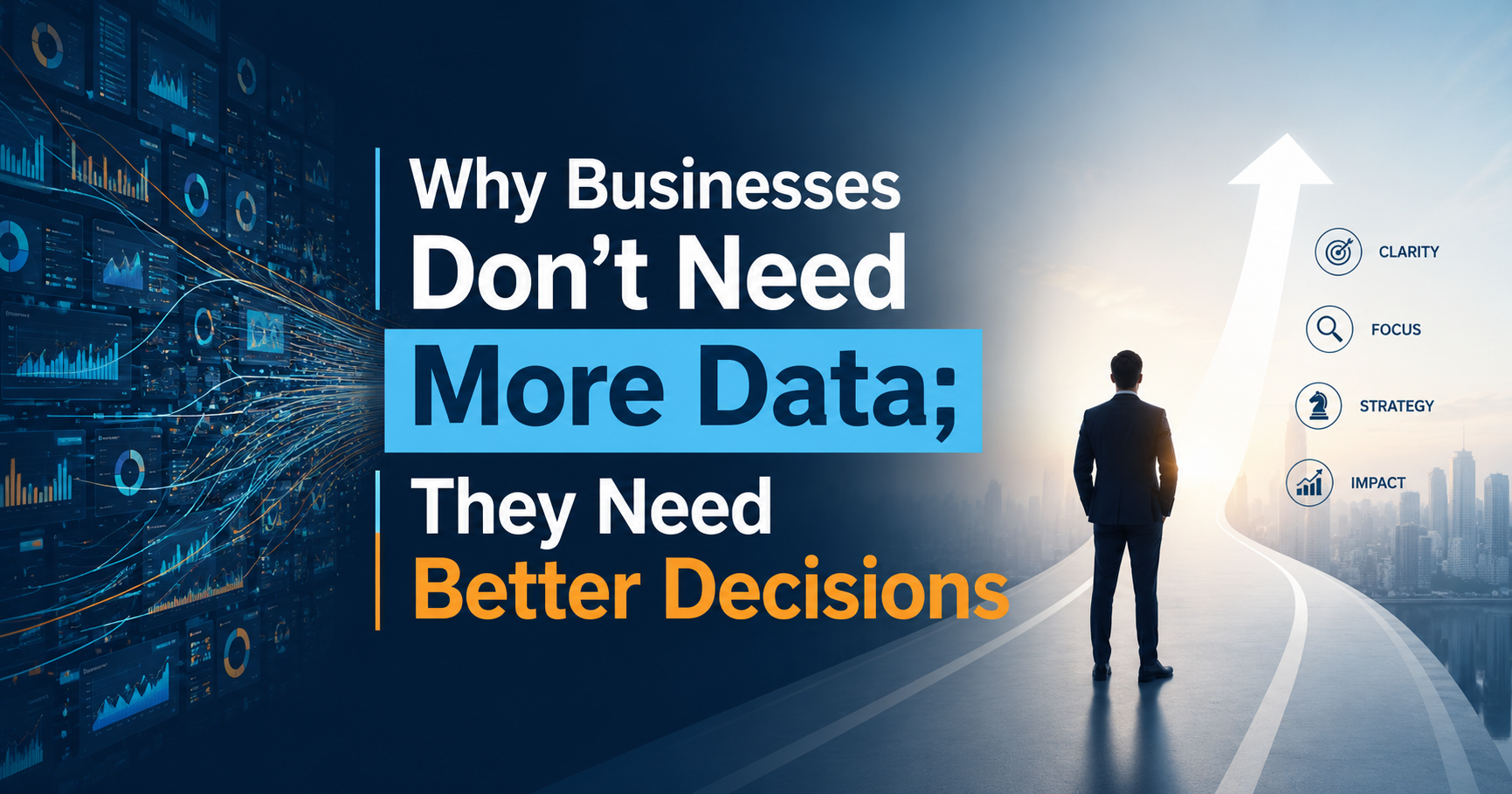
At first glance, dashboards seem like the answer. Need sales insights? Open a dashboard. Need operational performance? Open another dashboard.
Need customer analytics? There’s probably a dashboard for that too. The problem isn’t a lack of information. The problem is that information exists everywhere.
And when everything is important, nothing feels clear.
Data Doesn’t Automatically Create Clarity
One of the biggest myths in technology is that visibility equals understanding.
It doesn’t. You can have access to hundreds of metrics and still not know what action to take next. Because decision-making requires context. Not just numbers. A chart can tell you sales dropped. It can’t always tell you why. A report can show delays.
It doesn’t automatically explain what’s causing them. That’s where businesses often get stuck.
Most Teams Are Drowning In Information
Walk into almost any growing company and you’ll see the same pattern.
Sales has reports. Operations has reports. Finance has reports. Leadership has reports. Everyone has data. Yet meetings still begin with: “Can someone explain these numbers?” Because information exists. Alignment doesn’t.
The Hidden Cost Of Too Much Data
Interestingly, having excessive data can slow businesses down. Not because data is bad.
But because decision-makers become overwhelmed.
More reports mean: More interpretation. More validation. More discussion. And eventually, more delay.
Instead of helping teams move faster, data starts creating friction.
The Real Question Businesses Should Ask
Instead of asking: “What else can we measure?”
A better question is: “What decision are we trying to improve?”
This changes everything. Because suddenly, data becomes a tool. Not the objective. The goal isn’t collecting information. The goal is enabling action.
Why Context Matters More Than Volume
Imagine two companies. One tracks 300 metrics. The other tracks 20. Most people assume the first company has an advantage.
But if the second company knows exactly which 20 metrics influence business decisions, they’re often in a stronger position. Because context beats volume. Every time.
Data Silos Make Decisions Harder
Another challenge is fragmented information. Customer data lives in one system. Operational data lives somewhere else.
Financial data exists in another platform. Each system tells part of the story. But nobody sees the complete picture.
As a result, decisions require manual coordination. Teams spend time gathering information instead of acting on it.
Good Systems Surface What Matters
The best technology environments don’t overwhelm people with data. They filter complexity.
They surface relevant information. They highlight risks. They provide context. Most importantly, they help people focus on decisions rather than data collection. That’s where real business value emerges.
Decision Latency Is A Bigger Problem Than System Latency
Businesses often worry about system speed.
Page load times. API response times. Infrastructure performance. Those things matter. But decision latency can be far more expensive.
If a report takes five seconds to load, that’s usually manageable.
If leadership takes three weeks to make a decision because information is fragmented, that’s a much bigger problem.
And yet, many organizations focus on technical speed while ignoring decision speed.
AI Is Changing Expectations
Modern AI systems are increasing the pressure on businesses to improve decision-making.
Because AI can analyze data rapidly. Identify patterns. Generate recommendations. But even AI depends on structured information.
If data remains fragmented and inconsistent, AI simply produces fragmented and inconsistent insights faster. The foundation still matters.
What Minterminds Focuses On
At Minterminds, technology isn’t viewed as a collection of tools.
It’s viewed as a decision-enablement system. The goal isn’t simply creating dashboards.
It’s creating environments where information flows correctly, systems communicate effectively, and decisions become easier.
Because businesses don’t grow through reports. They grow through decisions. And better systems create better decisions.
Final Thought
The future won’t belong to businesses with the most data.
It will belong to businesses that can convert information into action the fastest.
Data is valuable. But clarity is more valuable. Visibility is useful. But alignment is more useful.
And ultimately, technology succeeds not when it shows people more information; but when it helps them make better decisions with the information they already have.