

Automation sounds like the obvious solution. If something is repetitive, automate it. If something takes time, automate it. If something depends on people, automate it. On paper, it makes perfect sense.
And in many cases, businesses do exactly that. They introduce automation tools. They set up workflows. They connect systems. And initially, it feels like progress. But after a while, something doesn’t add up.
Work Is Still Taking the Same Time
Even after automation, teams are still busy. They’re still following up. Still checking data. Still fixing small issues.
The work hasn’t disappeared. It has just changed form. Instead of doing tasks manually, people are now managing the automation itself. And that’s where the problem begins.
Automation Without Clarity Creates Noise
Automation works best when the process behind it is clear. Clear inputs. Clear outputs. Clear rules.
But most real-world processes aren’t that clean. There are exceptions. There are dependencies. There are edge cases. When these aren’t fully understood, automation doesn’t simplify things.
It complicates them. Now instead of manual steps, you have automated steps that don’t always behave as expected.
The Same Issues Start Showing Up Again
Over time, the same problems reappear. Data doesn’t match across systems. Workflows get stuck at certain steps. Outputs require manual correction.
The difference is that now, these problems are harder to trace. Because they’re happening inside automated systems. What used to be visible is now hidden.
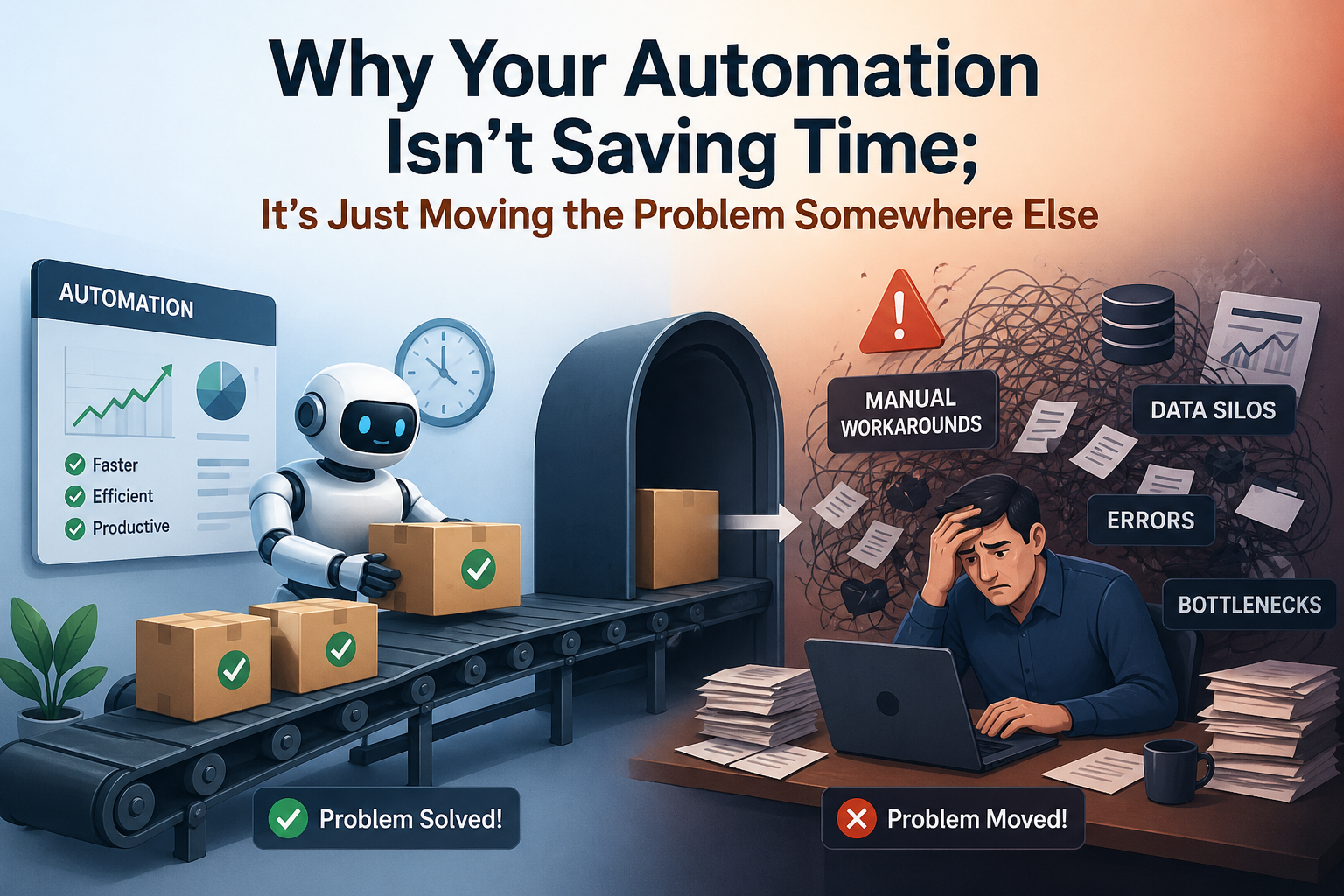
Automation Moves Problems — It Doesn’t Always Solve Them
This is the key point. Automation doesn’t fix broken processes. It accelerates them. If the process has gaps, automation pushes those gaps faster through the system.
Instead of one mistake, you get multiple. Instead of a delay, you get a bottleneck. The problem isn’t resolved. It’s redistributed.
Systems Start Becoming Harder to Control
As automation layers increase, systems become more complex. Multiple workflows run simultaneously. Different tools interact with each other. Data moves across several points. At this stage, control becomes difficult. If something goes wrong, it’s not always clear where the issue started.
Debugging takes longer. Fixing issues requires more coordination. And the efficiency gained from automation starts getting offset by the effort needed to manage it.
Why Integration Matters More Than Automation
One of the biggest reasons automation fails is poor integration. Tools are connected, but not aligned. Data moves, but not consistently. Systems interact, but not predictably.
Without proper integration, automation becomes fragile. Small changes in one system can break workflows in another. And that leads to more manual intervention.
Good Automation Feels Invisible
When automation is done right, you don’t notice it. There are no interruptions. No unexpected delays. No manual corrections. Work simply moves.
The system handles complexity in the background. And teams focus on actual work, not managing processes.
The Shift From Automation to System Design
At some point, businesses realise that adding more automation isn’t helping. That’s when the focus shifts.
From automating tasks… to designing systems. Understanding how workflows actually function. Identifying where dependencies exist. Ensuring data flows correctly. Automation becomes a part of the system; not the solution itself.
Where Minterminds Comes In
At Minterminds, automation is never the starting point. It’s the outcome. First, the system is understood. How work moves. Where it slows down. Where inconsistencies appear.
Then, processes are aligned. Only after that does automation make sense. Because now it’s built on clarity.
When Automation Actually Starts Saving Time
Once the foundation is right, automation behaves differently. It reduces effort. It removes repetitive work. It improves consistency. Not because the tools changed. But because the system behind them did.
Final Thought
Automation isn’t a shortcut. It’s a multiplier. If your process is clear, it multiplies efficiency.
If your process is broken, it multiplies problems. That’s why many businesses feel like automation isn’t helping. It’s not failing.
It’s exposing what needs to be fixed first. And once that’s addressed, automation finally starts doing what it was supposed to do: Making work easier.