

When businesses talk about software “not working,” they rarely mean it’s broken.
The system runs. The APIs respond. The dashboards load. From a technical standpoint, everything is functional. And yet, as the business grows, something changes.
Latency increases; not just in systems, but in decisions. Data inconsistencies appear across reports. Teams start relying on manual verification.
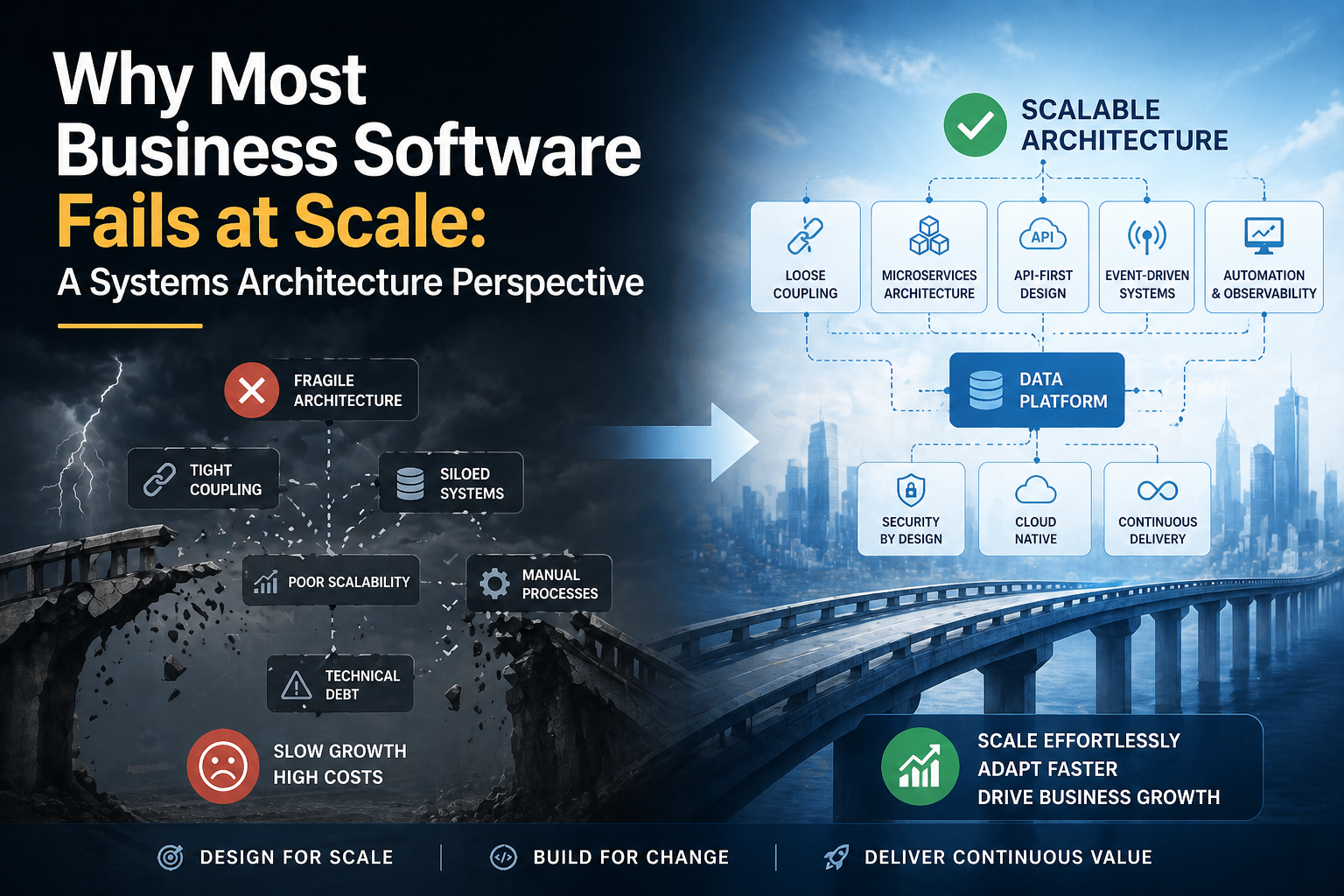
What worked well at a smaller scale begins to feel inefficient. This isn’t a failure of code. It’s a failure of architecture.
The Illusion of Early Success
Most systems are designed during a phase when the business is relatively simple.
Limited data volume. Fewer integrations. Straightforward workflows. Under these conditions, almost any architecture works.
Monolithic applications handle operations efficiently.
Direct database queries serve reporting needs.
Manual interventions are manageable.
The system feels fast, reliable, and sufficient. But this early success creates a false sense of scalability.
Scaling Introduces Non-Linear Complexity
As systems grow, complexity doesn’t increase linearly; it compounds. More users mean more concurrent requests. More transactions mean higher write frequency. More integrations mean more points of failure.
At this stage, architectural decisions that once felt efficient begin to create bottlenecks. Synchronous processes delay execution. Tightly coupled systems reduce flexibility. Centralized databases become performance constraints. The system still works. But it struggles under load.
Data Consistency Becomes a Core Challenge
One of the first technical symptoms at scale is data inconsistency. Different systems start reporting slightly different values.
This isn’t always due to incorrect logic. It’s often due to timing. Data pipelines may update at different intervals. Caching layers may serve outdated responses. APIs may depend on asynchronous updates.
Individually, these delays are negligible. But across systems, they create divergence. And once data diverges, trust erodes.
The Shift from Synchronous to Asynchronous Thinking
Early-stage systems often rely heavily on synchronous workflows. A request is made → processed → response returned. This works well when operations are simple and immediate consistency is required.
But at scale, synchronous systems introduce latency. Each dependency adds delay. Each failure cascades through the chain.
This is where asynchronous architectures become necessary. Event-driven systems decouple processes. Queues handle load distribution. Services operate independently. The system becomes more resilient. But also more complex to manage.
Integration Is the Real Bottleneck
Most businesses don’t operate with a single system. They use multiple platforms:
- CRMs
- Financial systems
- Operational tools
- Analytics engines
The challenge isn’t building these systems individually. It’s making them work together. Without proper integration, data becomes fragmented. Each system becomes a source of partial truth. Teams compensate by reconciling data manually. From an engineering perspective, this indicates a lack of unified data flow.
Designing for Data Flow, Not Just Functionality
A common mistake in software design is focusing on features instead of flow. What the system does vs how information moves. At scale, flow matters more.
How is data generated? Where is it stored? How is it updated across systems? Poorly designed data flow leads to redundancy, inconsistency, and latency. Well-designed flow ensures:
- Single source of truth
- Consistent updates
- Minimal manual intervention
Observability Becomes Critical
As systems grow more complex, visibility decreases. Without proper observability, diagnosing issues becomes difficult. Logs, metrics, and traces are no longer optional.
They’re essential.
Where is the delay occurring? Which service is failing? Why is data inconsistent? Without answers to these questions, systems become reactive instead of proactive.
The Trade-Off Between Flexibility and Control
Modern architectures aim for flexibility. Microservices, distributed systems, and API-driven design all support scalability. But they introduce trade-offs.
More services mean more coordination.
More flexibility means less centralized control. If not managed properly, this leads to:
- Increased operational overhead
- Complex debugging
- Higher maintenance cost
The goal isn’t maximum flexibility. It’s controlled flexibility.
Where Minterminds Comes In
At Minterminds, the focus isn’t just on building systems. It’s on designing architectures that hold under real-world conditions.
Understanding how systems interact. Ensuring data flows consistently. Balancing performance with scalability.
Because the real challenge isn’t writing code. It’s ensuring that code continues to work as the business grows.
Final Thought
Most software doesn’t fail because of technical errors. It fails because it wasn’t designed for scale. What works for 10 users often doesn’t work for 1000. What works for one system doesn’t work across five.
The difference lies in architecture. Not just what the system does. But how it behaves under pressure. And that’s where real engineering begins.