

If you’ve ever run a growing business, you’ve probably experienced this.
A tool that worked perfectly last year suddenly starts feeling… limiting.
Not because the software became worse. But because your business became different. It hired more people. Added new services. Expanded into new markets.
Introduced new approval processes. The software stayed exactly the same. Your business didn’t.
And that’s usually where the conversation around custom software begins.
Not because businesses want custom software. Because eventually, they need it.
Every Business Starts with Ready-Made Tools
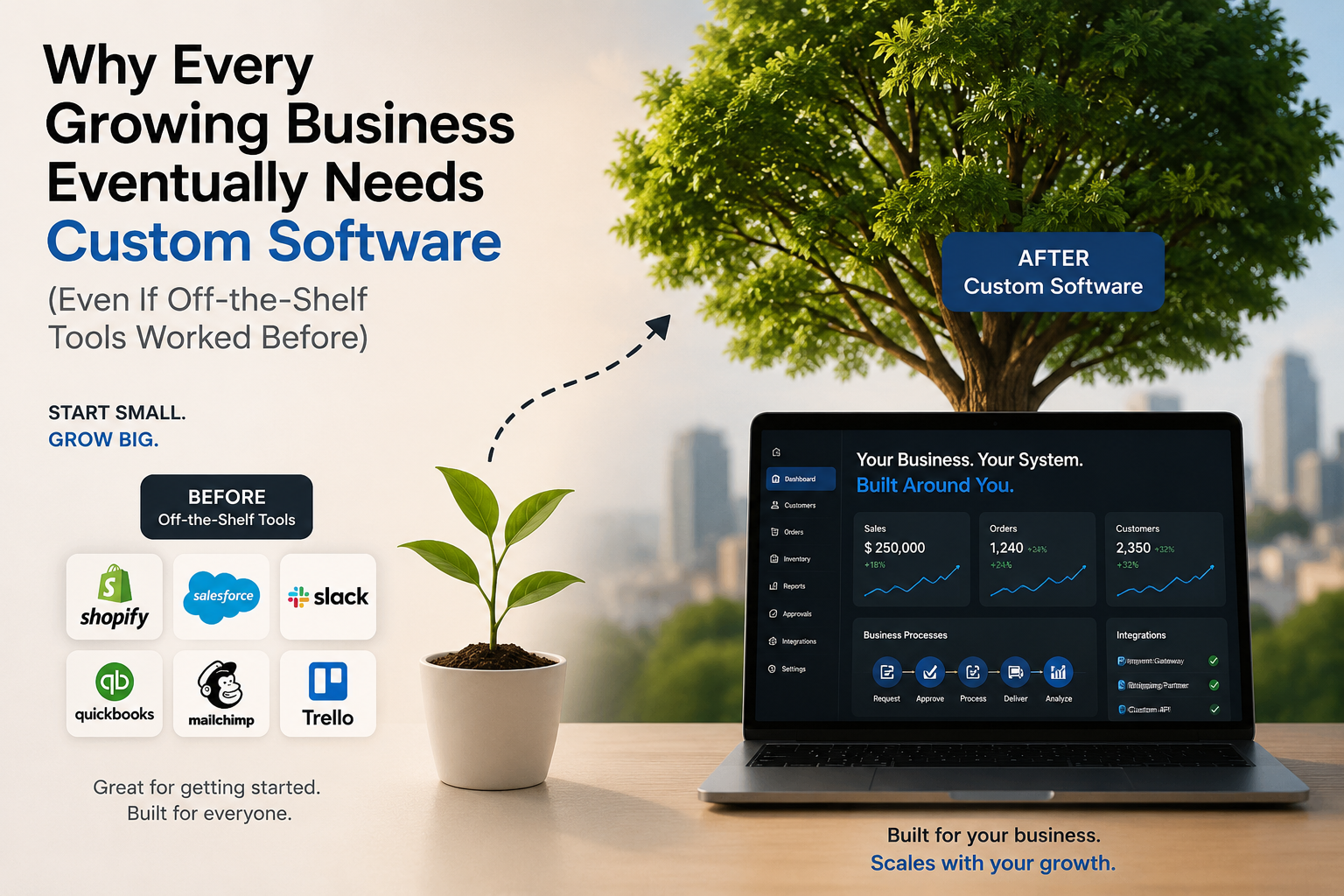
In the beginning, off-the-shelf software makes complete sense.
It’s affordable. Quick to set up. Easy to learn. You don’t need months of development.
You simply subscribe, configure a few settings, and start working.
For startups and small teams, that’s exactly the right decision. The problem comes later.
Growth Creates Unique Processes
No two companies grow in exactly the same way. One business may have three approval levels.
Another may need seven. One company might onboard clients in two steps. Another may require fifteen because of compliance. One operations team may work region-wise.
Another may work product-wise. These differences sound small. But they’re what make every business unique.
Unfortunately, generic software is designed for the average company. Not yours.
When Teams Start Saying…
“We’ll do this outside the system.”
Pay attention. That’s usually the first warning sign. Maybe it’s an Excel sheet. Maybe it’s a WhatsApp group.
Maybe it’s a shared Google Sheet. Maybe it’s a manual checklist. Nobody plans these workarounds.
They simply appear because the software can’t support the business anymore.
Slowly, the actual work starts happening outside the application you paid for.
The Cost Isn’t the Subscription
Many businesses hesitate to invest in custom software because of development cost.
But they rarely calculate the hidden costs they’re already paying.
Hours spent updating multiple systems. Managers following up for status. Teams entering the same information repeatedly.
Reporting delays. Human errors. Customer frustration.
These costs don’t appear on invoices. But they appear every single day.
Software Should Adapt to Your Business
One misconception about custom software is that it’s about adding more features.
It isn’t. The real purpose is alignment.
Instead of forcing your team to adjust their work around a platform… The platform adjusts around your workflow. That’s a completely different approach.
And it changes how people experience technology inside the business.
Integration Changes Everything
Growing companies rarely use just one application.
Customer data lives in a CRM. Invoices live somewhere else. Support tickets exist in another platform. Reports come from a different dashboard. The software isn’t necessarily the problem. The gaps between the software are.
When systems don’t communicate, people become the bridge.
And people shouldn’t have to move information manually between applications all day.
Good Software Makes Work Feel Simpler
Think about the best technology you’ve ever used.
You probably don’t remember its features.
You remember how easy it made your work. That’s the difference. Good software doesn’t constantly ask users to think.
It quietly removes friction. Approvals happen naturally.
Information updates automatically. Teams don’t need to ask where something is. They already know.
Building Software Isn’t Just Writing Code
Custom software development starts long before development begins.
The first step isn’t choosing a programming language.
It’s understanding the business.
How does work actually flow? Where are delays happening? Which tasks are repeated unnecessarily? Where do teams lose visibility?
Until those answers are clear, writing code is simply guessing.
Technology Should Grow With You
The biggest advantage of custom software isn’t today’s solution.
It’s tomorrow’s flexibility. Businesses evolve. New services are launched. Departments expand. Customer expectations change.
Technology should evolve alongside that growth; not become another obstacle.
That’s difficult with fixed platforms.
It’s much easier when software is designed around your business from day one.
Where Minterminds Comes In
At Minterminds, custom software isn’t treated as a collection of screens and features.
It’s viewed as the operating system behind a business.
Every workflow. Every approval. Every integration. Every decision.
The goal isn’t just to digitize work.
It’s to make work flow better.
Because when systems fit the business instead of forcing the business to fit the system, everything becomes simpler.
Final Thoughts
Buying software is easy. Building the right software takes understanding.
The businesses that scale successfully aren’t always the ones using the most technology.
They’re usually the ones using technology that truly reflects how they work.
Because software shouldn’t force your business to compromise. It should grow with it.
And that’s exactly where custom software creates its biggest value; not on launch day, but every day after.