

For the last few years, most conversations around AI at work have focused on assistance.
Ask AI to summarise a document. Ask it to draft an email. Ask it to analyse a spreadsheet. Ask it to find information. Useful? Absolutely.
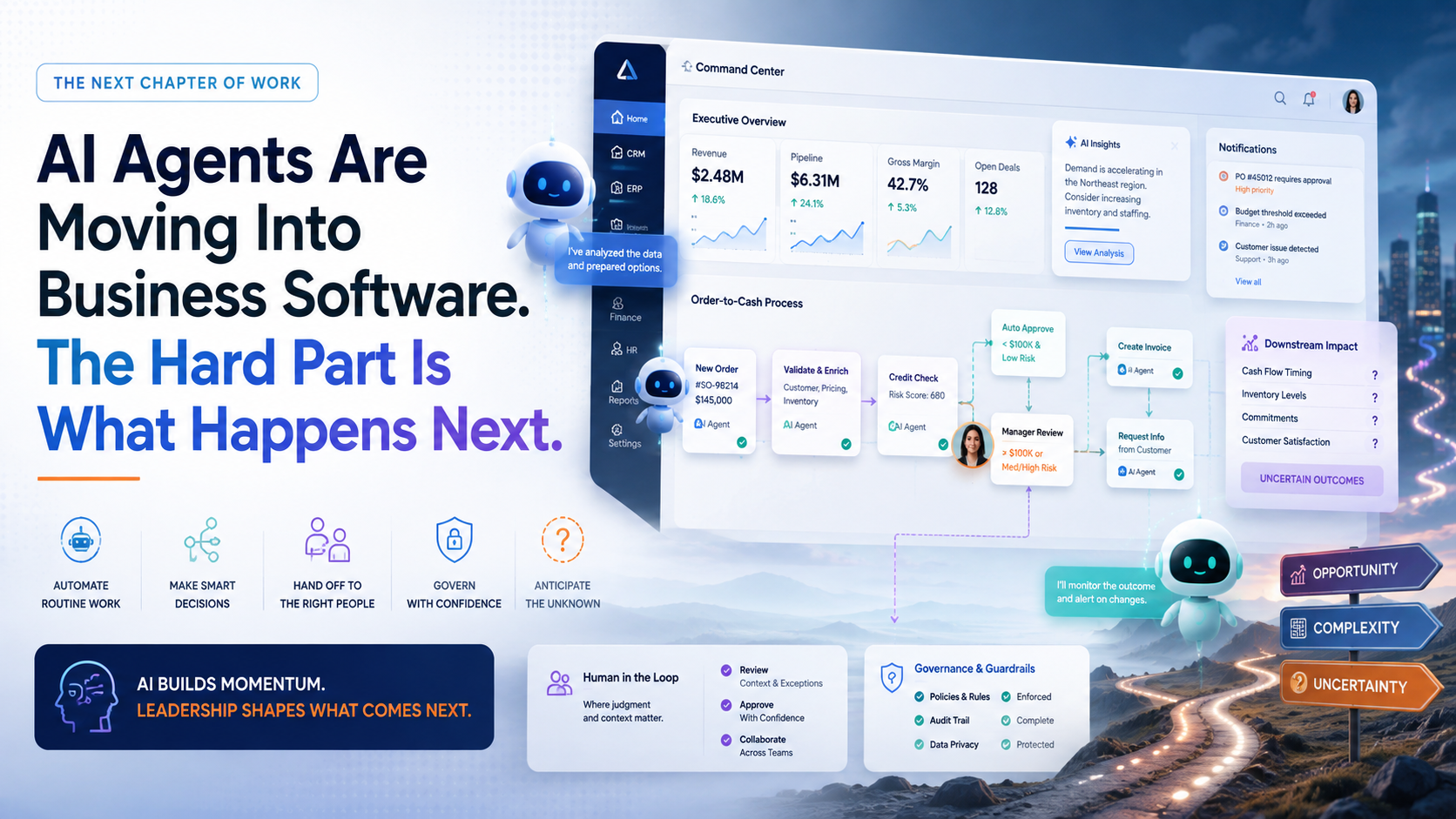
But something bigger is now happening. AI is beginning to move from answering questions to taking actions. Instead of simply telling an employee that an invoice is overdue, an AI agent may be able to check the account, prepare a follow-up, update the CRM, notify the right person, and trigger the next step in the workflow.
That is why agentic AI is becoming one of the most important enterprise technology conversations of 2026. Deloitte describes autonomous digital agents as one of the forces reshaping enterprise technology, while Gartner includes multiagent systems among its major strategic trends for the year.
The interesting part, however, is not that AI agents exist. It is what businesses have to change before those agents can actually be trusted with real work.
An AI Agent Is Not Just a Smarter Chatbot
The distinction matters. A chatbot usually waits for a user to ask something. An AI agent can potentially receive a goal, decide what steps are required, use connected tools, act on information, and continue until the task is complete.
Consider a customer onboarding process. A traditional AI assistant may answer questions about the process. An agentic system could potentially do much more.
It may check whether documents have been submitted, verify information against another system, create an internal task, update the customer record, schedule the next step, and alert someone when human approval is required.
That changes AI from a layer sitting beside business software into something that actively participates in the workflow. And that is a much bigger engineering problem.
Agents Need Access to Real Systems
An AI model can be impressive in isolation and still be almost useless operationally.
For an agent to perform meaningful work, it needs access to the systems where that work actually happens.
CRM. ERP. Databases. Project management tools. Internal applications. Communication platforms. Customer portals. APIs.
This means enterprise AI increasingly becomes an integration challenge.
The agent needs to know where information lives, what it is allowed to access, which system is authoritative, and what action should happen next.
If those systems are poorly connected, the AI does not magically fix the problem. It inherits it.
An organisation with fragmented software may simply end up with a faster way to move fragmented information around.
Permissions Suddenly Become Much More Serious
Giving an employee access to software is one thing. Giving autonomous software permission to act inside that software is another. Suppose an AI agent can update customer records.
Should it also be able to delete them? Can it approve refunds? Can it create invoices? Can it send messages externally? Can it access payroll information? These are not small technical details.
They determine how much damage a wrong decision could cause. Cisco’s 2026 enterprise AI direction reflects this shift. Its AgenticOps approach brings humans and AI agents into the same operational environment while emphasising controls around what agents can access and do.
The more capable agents become, the more carefully businesses need to design identity, permissions, approval levels, and audit trails.
“Human in the Loop” Needs to Be Designed Properly
It is easy to say that humans will remain in control.
The difficult question is where. Should a person approve every action? That defeats much of the purpose of automation. Should the agent act completely independently?
That may introduce unnecessary risk. The answer usually sits somewhere between the two. Routine, low-risk actions may run automatically. Higher-risk actions may require approval.
Unusual situations may be escalated. Certain decisions may always remain human. The system needs to understand those boundaries.For example, an agent could automatically send a standard payment reminder but require approval before changing payment terms.
That is much more useful than either extreme: complete manual control or unlimited autonomy.
AI Agents Make Observability More Important
Traditional software generally follows code written in advance.
AI agents introduce more variability. The same goal may involve different sequences of actions depending on available information. That creates a new question:
How do you know exactly what the agent did?
Businesses need visibility into agent behaviour.
Which systems did it access? Which data did it use? What action did it take? Why was that action triggered? Did it fail? Did it retry? Was a human involved?
These records become important for debugging, security, compliance, and simple operational trust.
Recent enterprise AI discussions are increasingly moving beyond model performance toward governance and continuous observability, particularly when AI begins operating inside important business processes.
Multiple Agents Will Make Architecture Even More Interesting
One agent is already complicated. Now imagine several. A sales agent qualifies an opportunity. A finance agent evaluates commercial information. An operations agent checks delivery capacity. A customer-service agent manages communication.
Each may have its own responsibilities, data access, and decision boundaries. Gartner’s inclusion of multiagent systems in its 2026 strategic technology trends reflects this direction.
At that point, the challenge is no longer simply building an AI feature. It becomes system orchestration. Agents need to share context without unnecessarily exposing information. They need to know which agent owns which task. They need ways to resolve conflicting actions.
And businesses need clear rules for when the workflow should stop and involve a person.
Tool Discovery Is Becoming Part of the Agent Ecosystem
Another interesting development is that agents may not always operate with a fixed list of capabilities.
Emerging approaches are looking at how agents can discover tools, resources, and services they need as tasks evolve.
O’Reilly’s August 2026 technology review highlighted growing work around agent resource discovery and orchestration.
This could make agents much more flexible. But it also makes governance harder. If an agent can discover a new tool, businesses need to know whether that tool is trusted, what data it receives, and what permissions it requires. More intelligence creates more capability. It also creates more decisions for system architects.
Security Has to Move at the Same Speed as Automation
Agents can operate quickly. That is one of their biggest advantages. It can also become one of their biggest risks. A poorly configured automated process may repeat a mistake hundreds of times before a person notices.
A compromised agent could potentially interact with several connected systems rather than one isolated application.
That is why security around agentic systems is becoming a serious enterprise concern rather than an afterthought.
Recent security discussions have increasingly focused on identity, access control, containment, and the ability to monitor agent activity across connected infrastructure. (TechRadar)
The question is no longer just:
“Is the AI model secure?”
It is:
“What can this AI reach if something goes wrong?”
Businesses Will Need Better Software Foundations Before Better Agents
This may be the most important point. Agentic AI puts pressure on everything underneath it. Poor APIs become obvious. Inconsistent data becomes dangerous. Weak permission structures become risky.
Disconnected systems limit usefulness. Unclear workflows confuse the agent just as easily as they confuse employees. Businesses may therefore discover that preparing for AI agents requires improving the architecture they already have.
That could mean cleaning up APIs, standardising data models, improving authentication, connecting systems, or redesigning workflows before adding intelligence on top.
In other words, AI readiness is increasingly becoming software readiness.
Where Minterminds Fits Into This Shift
For Minterminds, this is where the conversation becomes particularly relevant.
Building useful AI agents is not only about selecting a model. It involves understanding the entire environment around that model.
What systems need to connect? Which APIs are available? What information can the agent access? Where does human approval belong? How should failures be handled? What needs to be logged? How does the solution scale once usage increases?
These are software architecture and integration questions as much as AI questions.
And solving them properly is what turns an interesting AI demonstration into something a business can actually use every day.
Final Thoughts
AI agents are likely to become far more common inside enterprise software. But the businesses that benefit most will not necessarily be the ones that deploy them first.
They will be the ones that design the surrounding systems properly.
Clear permissions. Reliable integrations. Good data. Visible workflows. Strong security. Human oversight where it matters. The intelligence may sit in the AI model. But whether that intelligence becomes useful depends on everything built around it. That is why the next phase of enterprise AI will not be defined only by smarter models. It will be defined by better systems.