

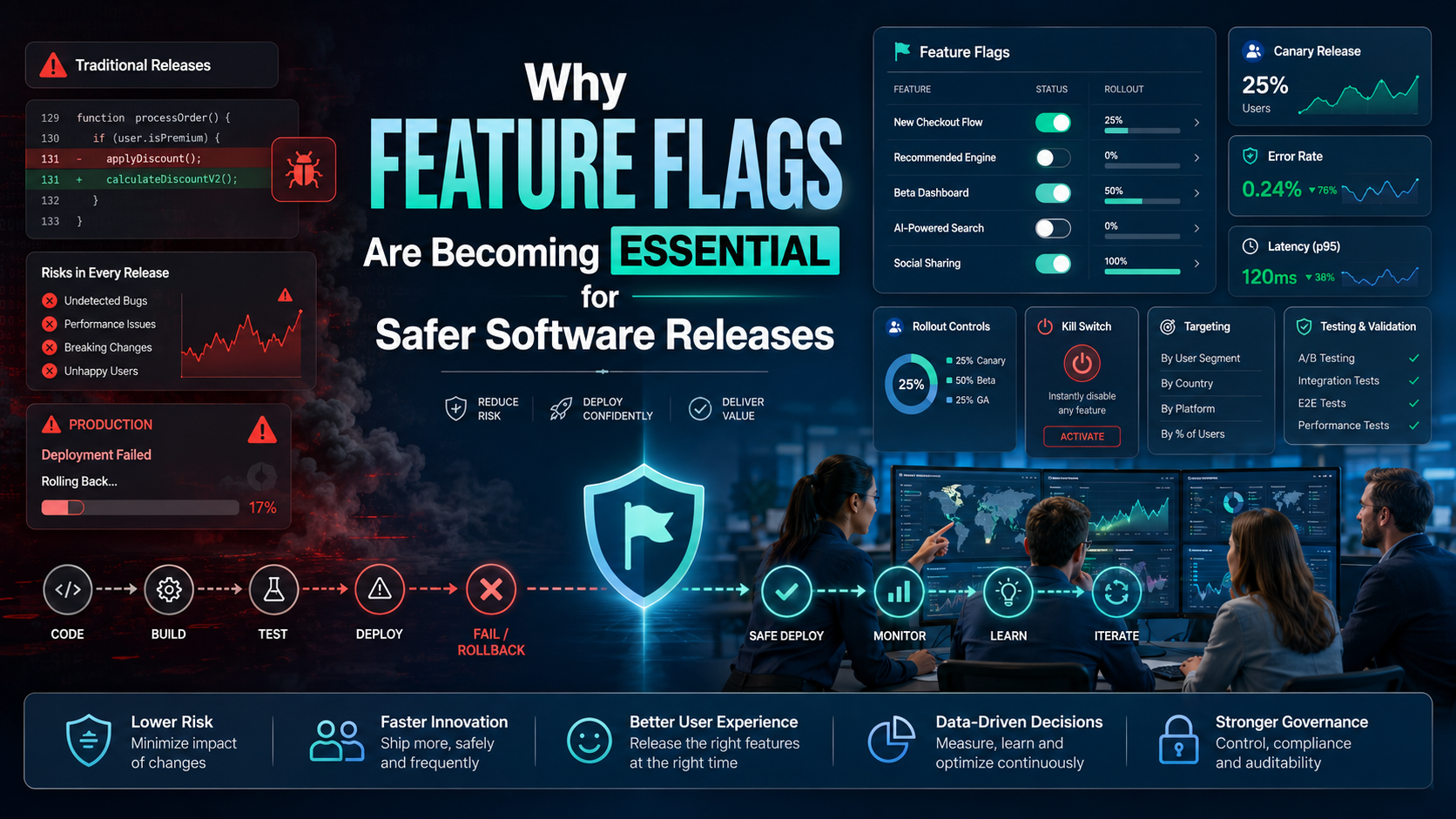

Releasing software used to feel like a big event.
A development team finished a feature, QA tested it, everyone waited for the deployment window, and then the new version went live for every user at once.
If something went wrong, the team rolled back the release and hoped the damage was limited.
That approach still exists, but modern software teams are increasingly moving away from all-or-nothing deployments.
One of the reasons is feature flags.
Feature flags allow teams to release code without immediately making the feature available to everyone. The code can exist in production while access is controlled separately.
That sounds like a small technical change.
In practice, it completely changes how software can be tested, released, and improved.
What Is a Feature Flag?
A feature flag is essentially a switch inside the application that controls whether a particular feature is active. Developers can deploy the code first and decide later who should actually see or use it.
For example, a company may build a new dashboard and deploy it to production. Instead of showing it to every customer immediately, the feature can initially be enabled for the internal team, then a small group of customers, and finally the wider user base.
If a problem appears, the feature can often be switched off without rolling back the entire application.
That gives teams much more control over what happens after deployment.
Deployment and Release Are Not the Same Thing
These two terms are often used as though they mean the same thing, but they do not have to.
Deployment means putting the code into the production environment.
Release means making that functionality available to users.
Feature flags allow those two steps to happen separately.
This matters because deployments become less stressful when every deployment does not automatically change the user experience.
A development team can deploy smaller pieces of code more regularly and decide when each feature is ready to be exposed.
That reduces the pressure around large release days.
Big-Bang Releases Carry More Risk
The bigger the release, the harder it becomes to understand what caused a problem.
Imagine twenty changes going live on Friday evening.
On Monday morning, customers start reporting errors.
The team now has to determine which of those twenty changes caused the issue, whether the problem affects everyone, and whether the whole release needs to be rolled back.
Smaller releases make that investigation much easier.
Feature flags support this by allowing teams to expose individual features independently.
If one feature behaves unexpectedly, it can be disabled while the rest of the deployment remains untouched.
Instead of reversing everything, the team isolates the problem.
Teams Can Test Features With Real Users
Testing environments are useful, but they can never reproduce production perfectly.
Real users behave differently.
Real traffic creates unexpected situations.
Real datasets contain edge cases that test environments may not include.
Feature flags allow organisations to introduce a new capability gradually.
A feature could begin with employees, then move to 1% of customers, then 10%, and eventually everyone.
During each stage, the team can observe how the software actually performs.
Are users completing the workflow?
Are errors increasing?
Is the new screen slower?
Are support tickets appearing?
Those answers can be collected before the entire customer base is affected.
Progressive Delivery Makes Releases Less Dramatic
This approach is often described as progressive delivery.
Instead of treating a software release as one moment, the release happens gradually.
A team may decide that a feature should initially reach users in one region, one subscription plan, or one customer segment.
If everything works as expected, availability expands.
This turns deployment into a controlled process rather than a single high-risk event.
For growing products, that can be particularly useful because the same feature may behave very differently across different customer groups.
Feature Flags Can Support A/B Testing
Not every software decision has an obvious answer.
Should a checkout button appear at the top or bottom?
Should onboarding have three steps or five?
Should users see one recommendation system or another?
Instead of debating internally, teams can test both options.
Feature flags can direct different groups of users toward different experiences.
The product team can then compare real behaviour.
Which version leads to more completed actions?
Which creates fewer support issues?
Which is easier for users to understand?
This moves product decisions away from assumptions and closer to evidence.
They Are Useful During Large System Migrations
Feature flags are not only useful for new interface features.
They can also help during major technical changes.
Imagine a company is replacing an old payment service with a new one.
Switching every transaction to the new system overnight would create considerable risk.
A feature flag can route a small percentage of transactions through the new service first.
The engineering team can monitor performance and compare results.
Once confidence increases, more traffic can gradually move across.
The same approach can be used for databases, APIs, recommendation engines, authentication systems, and other critical infrastructure.
Migration becomes incremental rather than abrupt.
Feature Flags Need Proper Management
There is a downside.
Feature flags can create complexity if teams keep adding them without removing old ones.
Imagine a codebase containing dozens of conditions such as:
If Feature A is enabled, do this.
If Feature B is disabled, do something else.
If Customer Group C has Feature D but not Feature E, follow another path.
Eventually, understanding application behaviour becomes difficult.
This is sometimes called feature flag debt.
Temporary flags should have clear owners and expiry plans.
Once a feature is permanently released, the old flag and unused code paths should normally be removed.
Otherwise, a tool designed to reduce release risk can eventually create technical complexity of its own.
Permissions Around Feature Flags Matter
A feature flag can change production behaviour instantly.
That means access should be treated seriously.
Not every employee should be able to activate a critical feature for every customer.
Teams need clear permissions around who can create, edit, enable, or disable flags.
Sensitive changes may also require approval.
Audit logs are useful as well.
If a flag changes unexpectedly, the team should be able to see who changed it, when it happened, and what value was used.
The more important the feature, the more important this control becomes.
Monitoring Should Be Connected to Rollouts
Gradual rollout only helps when the team can actually see what is happening.
Suppose a new feature is released to 5% of users.
The team should monitor relevant signals during that period.
Error rates.
Response times.
Failed transactions.
Customer complaints.
Feature usage.
Conversion behaviour.
If those metrics suddenly move in the wrong direction, the rollout can be paused.
In mature delivery systems, monitoring and feature management work together.
The question is not simply, “Did the deployment succeed?”
It becomes, “Is the feature behaving well enough to reach more users?”
Feature Flags Change How Teams Think About Failure
One of the most useful changes is psychological.
When every release affects everyone, teams naturally become cautious.
Developers may prefer fewer, larger releases because deployment feels risky.
Feature flags reduce that fear.
A feature can exist in production without being widely exposed.
Teams can test it carefully, observe behaviour, and change direction quickly.
Failure becomes smaller and easier to contain.
And when failures are cheaper, teams can experiment more confidently.
Where Minterminds Fits Into Safer Software Delivery
At Minterminds, software development is not only about building functionality.
How that functionality reaches real users matters too.
A reliable release process may involve feature flags, automated testing, CI/CD pipelines, monitoring, rollback strategies, access controls, and gradual rollout plans.
These practices become increasingly important as applications grow and releases happen more frequently.
The objective is simple: make software changes without turning every release into a high-risk event.
That requires thinking about delivery architecture alongside application architecture.
Final Thoughts
Modern software teams cannot eliminate every production issue.
What they can do is reduce how much impact each issue creates.
Feature flags help teams deploy code without immediately exposing every change, test functionality with smaller audiences, migrate systems gradually, and respond quickly when something behaves unexpectedly.
But they are not simply switches.
Used well, they become part of a wider software delivery strategy built around control, visibility, and smaller risks.
For businesses developing complex digital products, that matters.
Because faster software delivery should not mean taking bigger chances.
The better approach is to release faster while making each change easier to control.