

AI entered most workplaces as a tool. Someone opened ChatGPT to draft an email. Another employee used an AI assistant to summarise a document. A marketing team used it to generate ideas. Developers used it to review code.
These use cases saved time, but they still depended on one thing: a person had to start every task.
That is beginning to change. Businesses are now looking beyond individual AI tools and asking a more useful question: can AI become part of the actual workflow?
That shift matters because the next stage of enterprise AI is not simply about getting better answers. It is about connecting intelligence with the systems where work already happens.
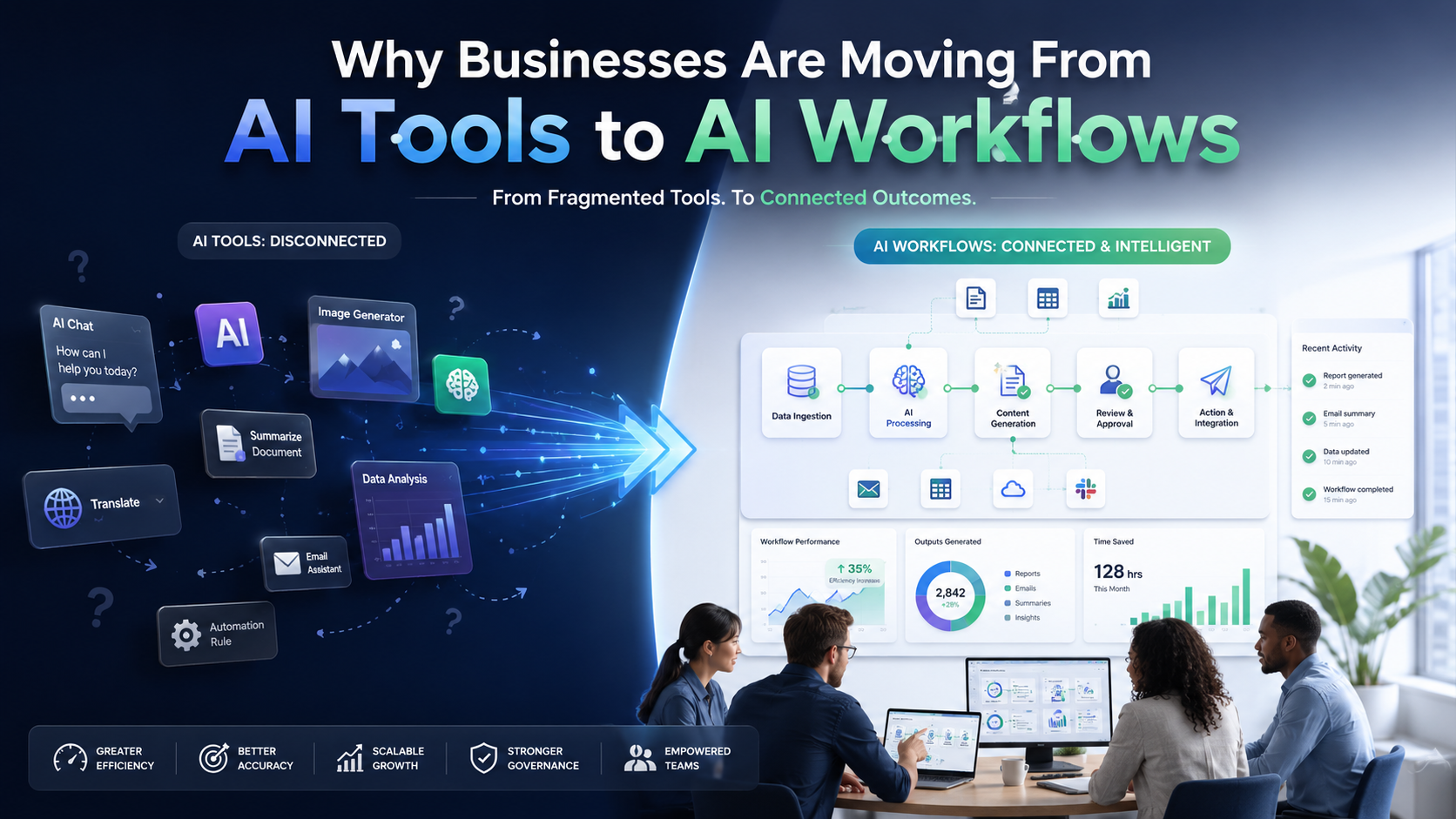
An AI Tool Helps With a Task. An AI Workflow Handles the Process.
The difference sounds small until you see it in practice. An AI tool usually helps a person complete one part of the job. An AI workflow connects several steps so that information can move from one action to the next with less manual effort.
Take a sales enquiry. With an AI tool, a salesperson might paste the enquiry into an assistant and ask it to draft a reply.
With an AI workflow, the enquiry could be captured automatically, checked against predefined criteria, added to the CRM, assigned to the right sales representative, and followed by a personalised response.
The AI is no longer sitting outside the process. It has become part of it.
The Real Value Comes From What Happens Between Applications
Most companies already have enough software. They have CRM platforms, accounting tools, project management systems, communication apps, databases, and internal dashboards.
The difficulty usually appears between those systems. A customer fills out a form, but someone still copies the details into another application. A payment is received, but another employee needs to update the order status. A project reaches a certain stage, but somebody has to remember to inform another department.
These handovers may look small, but they happen constantly. AI workflows become useful when they can understand what is happening in one system and trigger the appropriate action somewhere else.
That is why AI implementation is becoming closely connected to software integration.
AI Cannot Fix a Poorly Defined Process
There is a temptation to automate first and understand the workflow later. That usually creates problems.
If employees themselves are unclear about who approves a request, which system contains the correct data, or what should happen when something goes wrong, adding AI simply introduces another layer of uncertainty.
Before automating anything, the business needs to understand the process as it actually works.
Where does it begin? Who makes each decision? What information is required? Which exceptions occur regularly? Where does human judgment still matter?
Answering these questions may feel less exciting than building an AI feature, but this is often where the most important work happens. Good automation starts with process clarity.
Business Rules Still Matter
AI may be capable of reasoning, but businesses cannot leave every decision open-ended.
Some actions need clear rules. A customer refund below a certain amount may be approved automatically. A larger refund may need a manager. An incomplete application may trigger a reminder, while a suspicious application may need manual review. These boundaries help create predictable behaviour.
They also make it easier to decide where AI should act independently and where it should stop. The aim is not to remove human involvement completely. It is to use human attention where it actually adds value.
Data Quality Becomes Much More Important
An employee can often recognise when information looks wrong. Software may not.
If an AI workflow receives an incorrect customer address, duplicate account information, an outdated price, or missing order details, it may continue working with that information unless the system has been designed to detect the problem.
This makes data quality a fundamental part of AI adoption.
Businesses need to know which system contains the trusted version of each piece of information.
They also need processes for handling missing, conflicting, or outdated data.
Without that foundation, automation can make mistakes happen faster rather than reducing them.
Integrations Are Becoming Part of AI Architecture
Businesses sometimes treat integrations as an extra feature added near the end of development.
That approach becomes difficult with AI workflows.
An AI system may need information from several sources before making even a simple decision. It may need customer history from a CRM, order information from an internal database, payment status from another platform, and current inventory from an ERP.
If those connections are unreliable, the workflow becomes unreliable too.
This means APIs, authentication, data mapping, error handling, and synchronization need to be considered from the beginning.
The strength of the AI model matters.
But the strength of everything connected to it matters just as much.
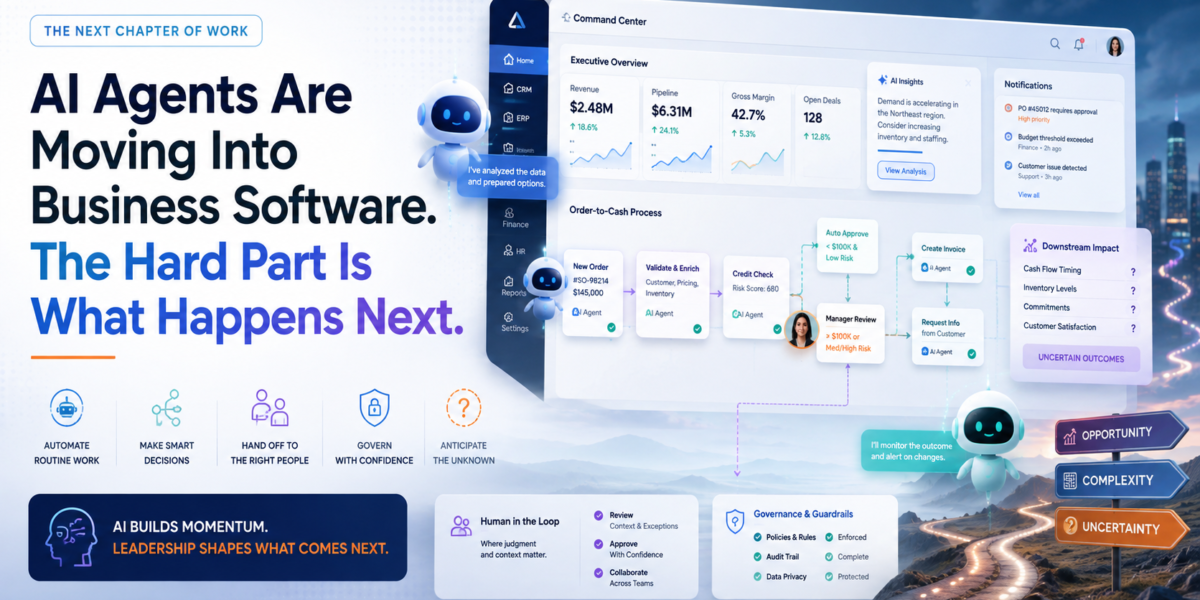
Human Approval Should Be Used Where Risk Is Higher
Not every business action carries the same level of risk.
Sending an internal reminder is very different from approving a payment.
Updating a lead status is different from changing a customer contract.
A useful AI workflow should recognise that difference.
Low-risk, repetitive actions can often be automated completely. More sensitive decisions can be prepared by the system but require human approval before completion.
This creates a more practical balance.
The business gains speed without handing over every decision to automation.
Human involvement becomes intentional rather than simply being present at every step.
The System Needs to Explain What Happened
When an employee performs an action, it is usually possible to ask them why.
Automated systems need a similar level of accountability.
Businesses should be able to see which information was used, what action was taken, when it happened, and whether anything failed along the way.
This becomes particularly important when AI participates in customer-facing, financial, operational, or compliance-related processes.
Without logs and visibility, diagnosing a problem can become difficult. A workflow should not simply work. The business should also be able to understand how it worked.
Start With Repetitive Work, Not the Most Complicated Process
When businesses first explore AI automation, they sometimes choose the biggest operational challenge they can find.
That is not always the best starting point. A smaller, repetitive workflow can provide much more useful learning.
It may be lead qualification, document classification, internal ticket routing, routine customer updates, or data entry between two systems.
These processes usually have clearer rules and lower risk. They allow the team to test integrations, permissions, monitoring, and human approval before introducing AI into more complicated areas. Successful adoption usually grows from practical use cases rather than ambitious demonstrations.
AI Workflows Should Be Designed Like Software Systems
It is easy to focus entirely on the intelligence layer. Which model should be used? Which prompt produces the best result? How accurate is the output?
Those questions matter, but an enterprise workflow needs much more.
- What happens when an API fails?
- What happens when required information is missing?
- Can an action be repeated accidentally?
- How does the system recover?
- Who receives an alert?
- Can a previous action be reversed?
These are traditional software engineering questions, and they remain important even when AI is involved.
In many ways, reliable AI automation depends less on having the cleverest model and more on having solid engineering around it.
Where Minterminds Fits Into AI Workflows
At Minterminds, the conversation around AI goes beyond adding an assistant to an existing application. The more important question is how AI can fit naturally into the way a business already operates.
That may involve integrating existing platforms, building custom applications, connecting APIs, automating repetitive steps, creating permission structures, or developing workflows where AI and human decisions work together.
The goal is not to insert AI everywhere. It is to identify where intelligence can genuinely remove friction and then build the software foundation required to support it properly.
Final Thoughts
The first phase of workplace AI was largely about individual productivity. The next phase is about operational flow.
Businesses are beginning to move from asking employees to use AI manually toward building systems where AI can participate in real processes. But that shift requires more than a model.
It requires clear workflows, connected software, reliable data, thoughtful permissions, human oversight, and strong engineering.
The businesses that get the most value from AI may not be the ones using the largest number of AI tools. They may simply be the ones that understand where AI belongs in the workflow and where it does not.