

For a long time, software companies competed on features. More features meant a better product. More options meant more value.
More functionality meant a stronger solution. And for years, that worked. Businesses kept buying software because every new platform promised something extra.
A new report. A new dashboard. A new automation. A new capability. But something has changed.
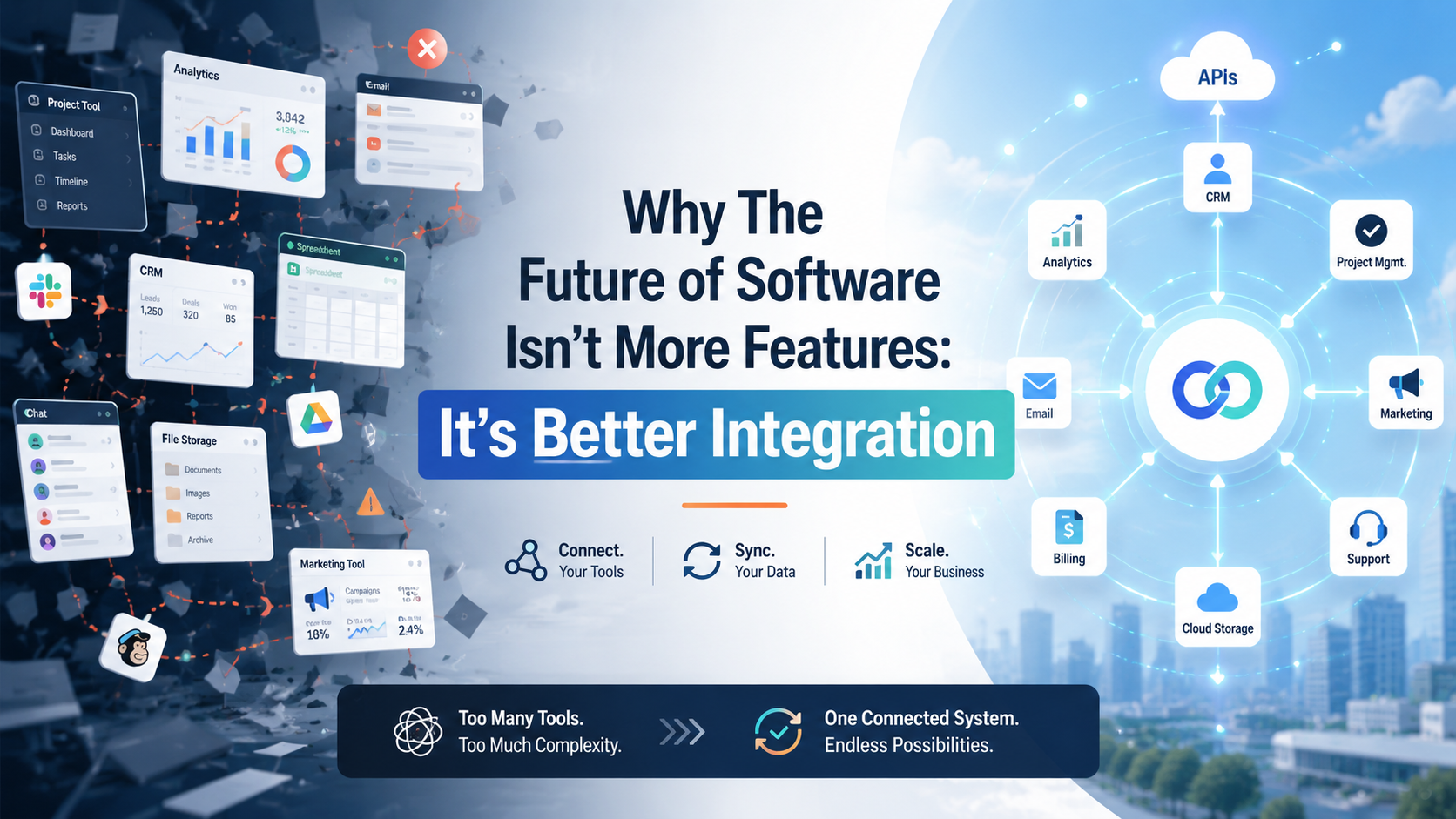
Today, most businesses don’t suffer from a lack of features. They suffer from too many disconnected ones.
The Average Business Has More Software Than Ever Before
A modern company might use: A CRM for sales. An ERP for operations. A helpdesk platform for support. An accounting tool for finance.
A project management system for execution. A communication platform for collaboration. Individually, every tool does its job.
The challenge begins when work needs to move between them. Because business doesn’t happen inside one application. Business happens across all of them.
Every Disconnected System Creates Friction
Imagine a customer places an order. Sales captures the information. Operations needs it. Finance needs it. Support eventually needs it too.
Now imagine that information doesn’t flow automatically. Someone has to transfer it. Someone has to verify it. Someone has to update another system.
What seems like a small task quickly becomes operational overhead. And when this happens hundreds or thousands of times, the cost becomes significant.
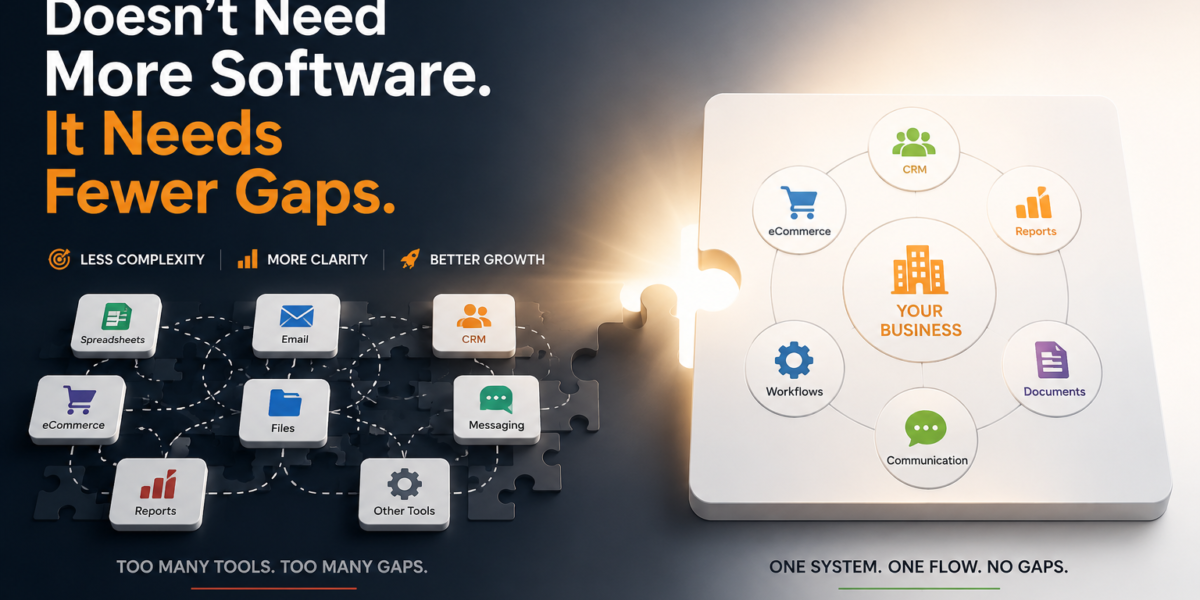
Most Businesses Are Running On Digital Islands
This is one of the biggest hidden challenges in modern organizations.
Systems exist. Data exists. Technology exists. But everything operates in separate environments.
The CRM knows something the ERP doesn’t. The reporting platform has different numbers. The support team sees incomplete information. Everyone is working. But nobody is working from the same reality.
The Problem Isn’t Technology
Interestingly, this isn’t a technology problem. It’s a connectivity problem. Most organizations already own powerful software.
The issue is that these systems weren’t designed to work together seamlessly.
As a result:
Data gets duplicated. Processes get delayed. Teams lose visibility. Decision-making slows down. And eventually, growth becomes harder than it should be.
Why Integration Is Becoming More Important Than Development
Ten years ago, the biggest challenge was building software. Today, the bigger challenge is connecting software.
Modern organizations depend on entire technology ecosystems. Each system generates information. Each platform performs a specific function.
The real value comes when all of them operate as a single environment.
That’s where integration becomes critical.
APIs Changed Everything
The rise of APIs transformed how businesses think about technology. Instead of building everything from scratch, companies can connect systems together.
Customer information can flow automatically. Workflows can trigger actions across platforms. Data can remain synchronized.
But having APIs available doesn’t automatically create integration. Architecture still matters. Planning still matters. System design still matters.
Bad Integration Creates Invisible Costs
Unlike a system outage, poor integration rarely creates obvious failures.
Instead, it creates small inefficiencies. Repeated data entry. Manual validation. Status update meetings. Cross-checking reports. Extra emails. Extra approvals.
Individually, these activities seem minor. Collectively, they consume enormous amounts of time.
Good Integration Creates Operational Speed
When systems communicate properly, something interesting happens.
Work accelerates naturally. Teams stop chasing information. Managers stop requesting manual updates. Departments stay aligned automatically.
People spend less time coordinating and more time executing. That’s the real value of integration. Not convenience. Speed.
AI Is Making Integration Even More Important
The rise of AI has amplified this challenge. AI systems rely on connected data. Disconnected systems create fragmented intelligence.
An AI assistant can’t provide meaningful insights if customer information, operational data, and financial information all live in separate silos.
The quality of AI depends heavily on the quality of integration.
Which means businesses that solve connectivity problems today will be better positioned for AI tomorrow.
Integration Is No Longer An IT Project
Historically, integration was viewed as a technical initiative.
Something handled by engineering teams. That’s no longer true. Integration now affects:
- Customer experience.
- Operational efficiency.
- Decision-making.
- Scalability.
- Business growth.
It’s become a strategic priority rather than a purely technical one.
Where Minterminds Fits
At Minterminds, software isn’t viewed as individual applications. It’s viewed as an ecosystem. The focus isn’t just building platforms.
It’s ensuring those platforms communicate effectively. Ensuring information moves without friction. Ensuring workflows remain connected.
And ensuring businesses operate from a single source of truth. Because technology creates the most value when it behaves like one unified system; not ten separate tools.
Final Thought
The next generation of successful businesses won’t necessarily have the most software.
They’ll have the most connected software. Because the future isn’t about adding more platforms. It’s about making existing platforms work together intelligently.
In a world full of technology, competitive advantage increasingly comes from flow.
The flow of information. The flow of decisions. And ultimately, the flow of business itself.