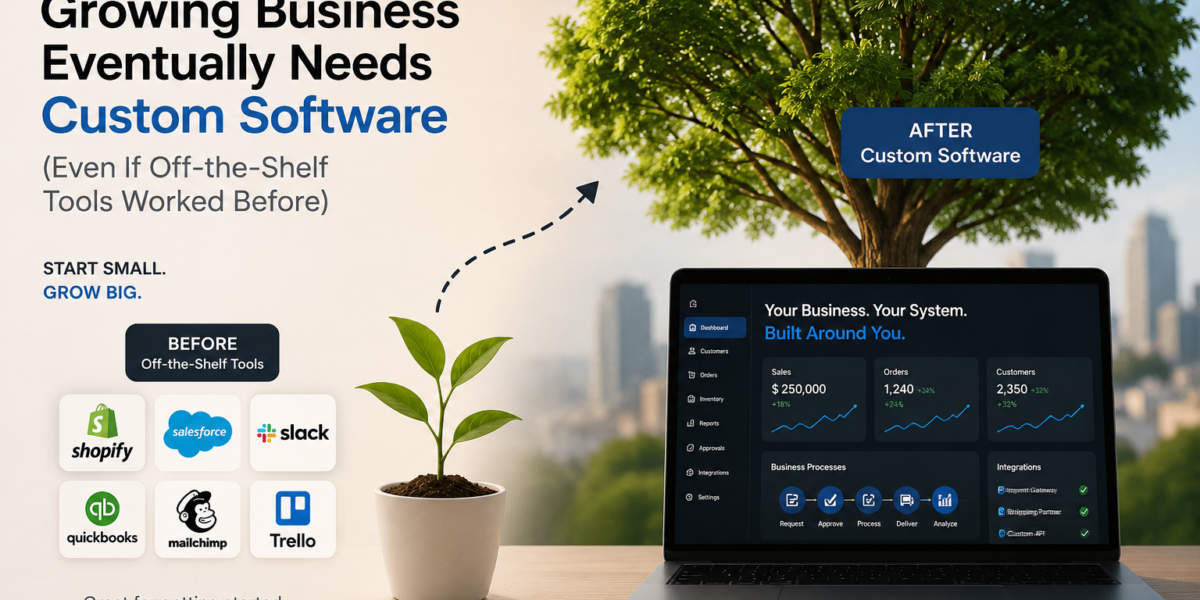



As businesses grow, so do their challenges. What worked for a team of five often starts falling apart when the company grows to fifty. Tasks become more complex, departments expand, customer expectations rise, and suddenly, the software that once felt like the perfect solution starts becoming a daily frustration.
This is where many businesses find themselves stuck. They continue using generic software because it’s familiar, even though it no longer supports the way they work. Over time, these small compromises add up, affecting productivity, collaboration, and ultimately, growth.
The Reality of One-Size-Fits-All Software
Off-the-shelf software is built for the masses. It is designed to solve common business problems, which makes it a great starting point for startups and small teams.
However, no two businesses operate in exactly the same way.
A logistics company has completely different workflows than a healthcare provider. An e-commerce brand handles customer journeys differently from a manufacturing business. Yet many businesses are forced to adapt their operations to fit software that was never built with their specific processes in mind.
Instead of the software supporting the business, the business starts adjusting itself to the software.
The Hidden Costs Businesses Often Ignore
Most companies focus on subscription costs when evaluating software. The real expenses, however, are often hidden.
Employees spend hours manually transferring data between systems.
Teams rely on spreadsheets because their existing platform cannot handle a specific workflow.
Departments use different tools that don’t communicate with each other, leading to duplicate work and inconsistent information.
While these issues may seem minor individually, together they consume hundreds of working hours every year.
The cost isn’t just financial. It also impacts employee productivity, customer experience, and decision-making.
Growth Brings Complexity
As your business expands, new challenges naturally emerge.
You may need approval workflows that involve multiple departments.
Customer information needs to be accessible across teams.
Inventory, billing, sales, and support all need to work together instead of operating in isolation.
Generic software often requires additional plugins, third-party integrations, or manual workarounds to meet these growing needs. Eventually, businesses end up managing multiple disconnected tools rather than one efficient ecosystem.
Instead of simplifying operations, technology starts creating new problems.
Why Custom Software Makes Sense
Custom software is designed around the way your business already works.
Instead of forcing your team to change established processes, it supports them by automating repetitive tasks, simplifying operations, and improving collaboration.
Whether it’s an internal dashboard, a customer portal, a mobile application, or an enterprise management system, every feature is built with a clear purpose.
This means employees spend less time navigating complicated systems and more time focusing on meaningful work.
Scalability Should Never Be an Afterthought
One of the biggest advantages of custom software is scalability.
Businesses evolve constantly. New products are introduced, teams grow, customer expectations shift, and markets change.
A scalable software solution evolves alongside the business instead of becoming obsolete after a few years.
Need additional user roles?
Want to integrate AI-powered features?
Planning to launch a customer app?
Expanding to multiple locations?
With the right development strategy, these additions become part of the system instead of requiring an entirely new platform.
Integration Creates Efficiency
Most businesses today use multiple digital tools.
Accounting software. CRM systems. Marketing platforms. Payment gateways. Inventory management.
The challenge isn’t having these tools; it’s getting them to work together.
Custom software can act as the central hub that connects different systems, allowing information to move automatically instead of relying on manual updates.
This reduces errors, improves reporting, and gives leadership a clearer picture of business performance.
Better User Experience Means Better Results
Technology should make work easier.
Unfortunately, many employees spend more time figuring out software than actually using it.
A well-designed digital solution focuses on usability just as much as functionality.
Simple navigation, faster workflows, mobile accessibility, and intuitive interfaces improve adoption across teams and reduce training time.
The result is software that people actually enjoy using.
Technology Should Support Business Goals
Software isn’t just another business expense.
It’s an investment in operational efficiency.
When technology aligns with business objectives, companies can respond faster to market changes, serve customers more effectively, and make data-driven decisions with confidence.
The goal isn’t to adopt more technology.
It’s to adopt the right technology.
Building Solutions That Grow With Your Business
Every successful business reaches a stage where generic solutions are no longer enough.
That’s when custom software shifts from being a luxury to becoming a strategic advantage.
At Minterminds, we help businesses transform ideas into scalable digital solutions through custom software development, website development, mobile app development, UI/UX design, and digital marketing. Rather than offering one-size-fits-all products, we focus on creating technology that aligns with your business goals today while remaining flexible enough to support tomorrow’s growth.
The businesses that grow sustainably aren’t always the ones with the biggest budgets.
They’re the ones that invest in systems designed to grow with them.