

Every business celebrates growth.
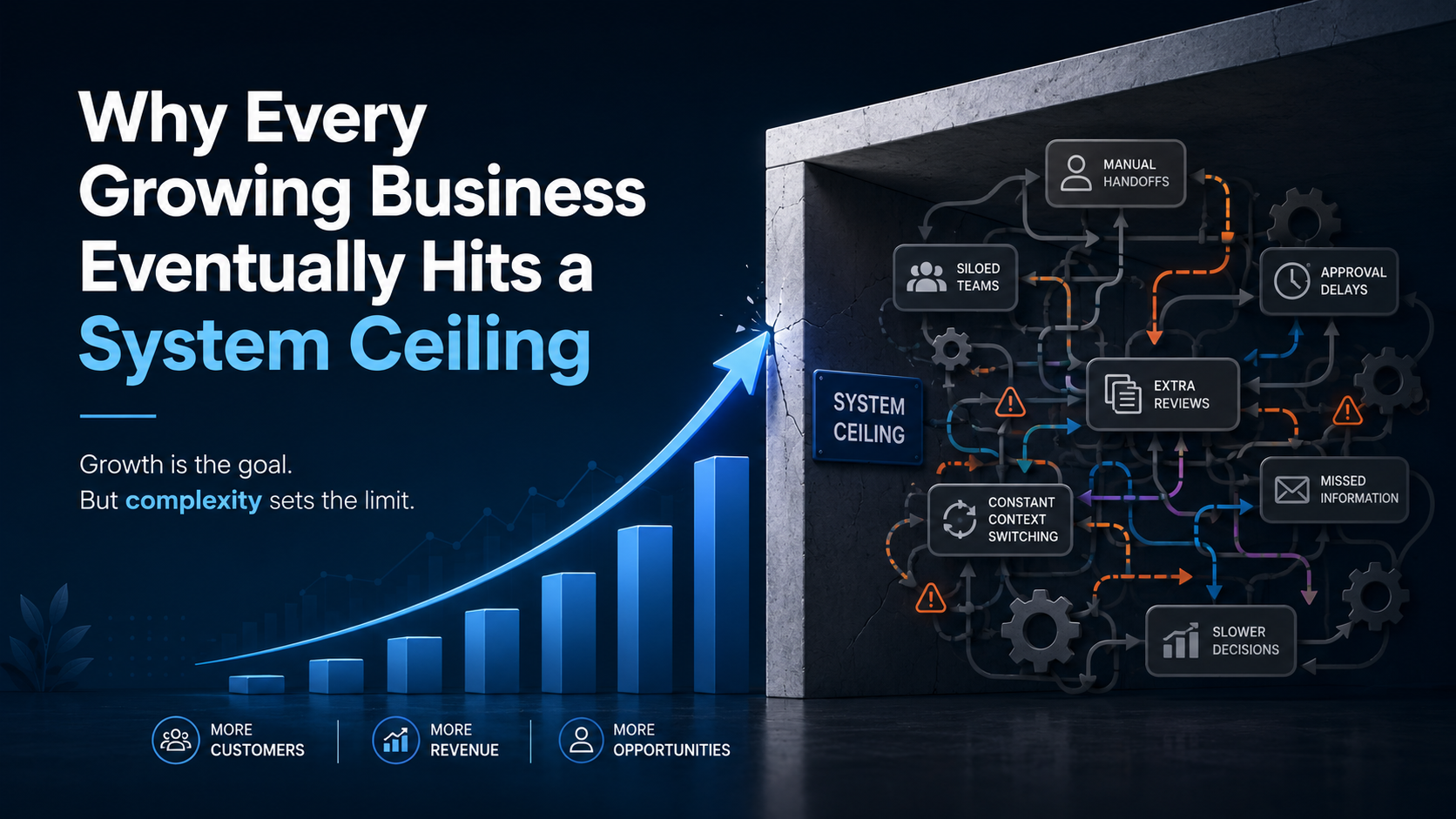
More customers. More revenue. More employees. More opportunities. Growth is the goal.
But very few businesses prepare for what growth quietly brings with it. Complexity. And unlike revenue, complexity doesn’t show up on a dashboard. It shows up in everyday work.
Everything Starts Taking “Just a Little Longer”
Growth rarely breaks a business overnight.
Instead, it changes how work feels. Approvals take an extra day. Reports need one more review. Customer requests bounce between departments.
Projects need another meeting before moving forward. Individually, none of these seem like major issues. Collectively, they become a pattern. A pattern that slowly reduces speed.
The Business Didn’t Change Overnight
This is what makes system ceilings difficult to recognise.
Leadership often assumes the market has become more competitive.
Teams assume workloads have increased. Managers assume people need better training. Sometimes those things are true.
But often, the business has simply outgrown the systems supporting it.
Growth Exposes What Small Teams Can Hide
When teams are small, people naturally fill operational gaps.
They remember customer details. They know where information is stored. They solve problems through conversations instead of systems.
That’s completely normal. But as the organisation grows, those informal processes stop working.
Knowledge becomes scattered. Dependencies increase. Communication slows.
The same habits that once made the business agile now become bottlenecks.
Software Doesn’t Create Scalability By Default
Buying software feels like progress. Building software feels even better. But software alone doesn’t create scale.
A system only becomes scalable when it’s designed around how the business actually operates.
Not how it operated two years ago. Not how it was expected to operate. How it operates today.
Every Manual Process Has an Expiry Date
One manual approval isn’t a problem. One spreadsheet isn’t a problem. One follow-up call isn’t a problem.
The challenge begins when those “temporary” processes become permanent.
Manual work grows alongside the business.
Until eventually people spend more time managing work than delivering it.
That’s usually the first sign the organisation has reached its system ceiling.
Information Starts Traveling Slower Than The Business
One of the biggest indicators of operational maturity isn’t revenue.
It’s information flow. Can teams access accurate information instantly? Or does every decision require multiple messages, meetings, and validations?
The faster information moves, the faster the business moves.
When information slows down, growth slows with it.
Departments Begin Optimizing For Themselves
Another interesting shift happens during growth.
Each department starts solving its own problems.
Sales adopts one tool. Operations builds another process. Finance creates its own reporting method. Every decision makes sense locally.
But globally, the organization becomes fragmented.
Instead of one connected business, multiple disconnected systems emerge.
Visibility Becomes Harder, Not Easier
Ironically, growing businesses often have more reporting than ever before.
Yet leadership feels less informed.
Why? Because information is spread across different systems.
Different formats. Different teams. By the time reports reach decision-makers, the business has already moved forward.
The challenge isn’t access to information.
It’s access to the right information at the right time.
Scaling Isn’t About Hiring More People
Many organizations respond to operational pressure by expanding teams.
More coordinators. More managers. More operations staff. Sometimes that’s necessary.
But hiring people to compensate for inefficient systems rarely solves the root problem.
It simply increases operational cost.
Scalable businesses don’t grow by adding coordination.
They grow by reducing the need for it.
Technology Should Remove Complexity; Not Add To It
The best technology isn’t the software with the longest feature list.
It’s the software people barely notice.
Because everything simply works.
Tasks move naturally.
Approvals happen automatically.
Information reaches the right people without anyone asking for it.
Good systems reduce thinking about processes so teams can focus on outcomes.
Where Minterminds Makes The Difference
At Minterminds, software development starts with one question:
“Where is the business losing momentum?”
Not where another feature can be added.
Not where another dashboard can be built.
But where operational flow is slowing down.
From there, technology is designed to remove friction, connect workflows, and support future growth, not just today’s requirements.
Because scalable software isn’t built for where your business is.
It’s built for where your business is going.
Final Thought
Every growing business eventually reaches a point where effort increases faster than results.
Most assume they need more people.
More tools. More meetings. But often, what they actually need is a better system.
Because businesses don’t stop growing when demand disappears.
They stop growing when their systems can no longer keep up.
And the companies that continue scaling successfully are usually the ones that recognise that ceiling before everyone else does.